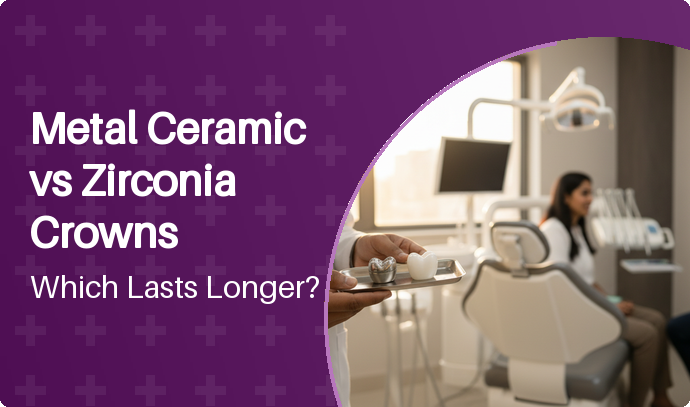
Metal Ceramic vs Zirconia Crowns: Which Lasts Longer?
by Galaxy Dental CarePublished : 23 October 2026
Metal ceramic vs zirconia is the question most patients face when a dentist says they need a crown. Both protect a damaged tooth, but they differ in strength, appearance, and how long they last. Zirconia crowns offer higher flexural strength, typically 900 to 1,200 MPa, and better aesthetics without any metal. Metal ceramic crowns, also called porcelain-fused-to-metal, remain strong overall and cost less. At Galaxy Dental Care, our prosthodontists check your bite force, gum health, and the tooth’s position before recommending either material. We use in-house OPG and CBCT scans to assess bone support and space. By the end of this article, you will know which crown material matches your needs and what to ask at your consultation.
Key takeaways
Zirconia crowns resist fractures better and suit patients with heavy biting forces.
Metal ceramic crowns cost less but may show a dark metal line near the gums over time.
Both materials have a median survival of 10 to 15 years with proper care.
Your dentist should check bite force, gum health, and tooth position before choosing.
Galaxy Dental Care offers both options with digital scans for precise fitting.
What is the difference between metal ceramic and zirconia crowns?
A metal ceramic crown has a dark metal core covered by porcelain, giving it strength but hiding some light the way natural teeth do. A zirconia crown is made from a white ceramic material called zirconium dioxide, which is strong enough to work without a metal base. This means zirconia lets more light pass through, so it looks more like a real tooth, especially on front teeth. Metal ceramic crowns have been used longer and dentists know their behavior well. Zirconia is newer but has been studied extensively, with clinical data showing similar survival rates to metal ceramic over time.
At Galaxy Dental Care, our prosthodontists use Dental Crowns made from both materials. The choice depends on where the tooth sits, how hard you bite, and whether you grind your teeth at night.
Which crown material is stronger?
Zirconia crowns have higher flexural strength, ranging from 900 to 1,200 MPa, which means they resist cracking under pressure better than the porcelain layer on metal ceramic crowns. Monolithic zirconia, made from a single solid piece, is particularly strong and has been used successfully on molars for patients who grind or clench. Metal ceramic crowns are still strong overall because the metal core underneath rarely breaks, but the porcelain coating can chip or crack if hit hard.
For back teeth that take the most force, zirconia often wins. For front teeth where the bite is lighter, either material works if placed well. Our team checks your bite pattern with digital tools before recommending one.
Strength factor
Metal ceramic
Zirconia
Core material
Metal alloy
Zirconium dioxide ceramic
Flexural strength
Depends on porcelain layer
900 to 1,200 MPa
Fracture risk
Porcelain veneer can chip
Very low in monolithic form
Best for heavy biting forces
Possible with caution
Preferred choice
Which looks more natural?
Zirconia looks more natural because it has no dark metal underneath to block light. Metal ceramic crowns can develop a gray line at the gum edge as gums recede with age, which some patients find noticeable on front teeth. The porcelain on metal ceramic can match tooth color well, but it never quite matches the translucency of real enamel because the metal base absorbs light rather than letting it pass through.
If your smile shows your teeth prominently, zirconia is usually the better aesthetic choice. For back teeth that others rarely see, the appearance difference matters less. Patients concerned about metal allergies or sensitivities also prefer zirconia because it contains no metal at all.
Aesthetic factor
Metal ceramic
Zirconia
Translucency
Lower, metal blocks light
Higher, closer to natural tooth
Gum line over time
May show dark metal edge
No metal, no gray line
Color matching
Good with porcelain layer
Excellent, especially layered zirconia
Metal allergy risk
Present in some alloys
None, fully ceramic
How long do metal ceramic and zirconia crowns last?
Both materials have a median survival of 10 to 15 years, and zirconia often exceeds 15 years with proper maintenance. A 2025 clinical study found 91.5% survival for both monolithic zirconia and metal ceramic crowns over the follow-up period, with similar types of complications. The main reasons crowns fail are decay at the edge, gum disease loosening the fit, or the crown coming off due to cement failure, not the material itself breaking.
Your habits matter more than the material. Grinding your teeth, chewing ice, or skipping cleanings shortens any crown’s life. At Galaxy Dental Care, we schedule follow-up visits to check the seal and gum health around your crown.
How do dentists decide which crown to use?
The dentist examines three things before choosing: the tooth’s position in your mouth, how much force you apply when biting, and the health of your gums. Front teeth need better aesthetics, so zirconia or layered zirconia is common. Molars need maximum strength, so monolithic zirconia or metal ceramic may be chosen. Patients with heavy grinding habits often get zirconia for its fracture resistance.
Before placing any crown, our prosthodontists take an OPG full-mouth X-ray or CBCT 3D scan to check bone support and nerve position. We also review your medical history, current medicines, and conditions like diabetes that affect healing. This is the same careful evaluation we use for Dental Implants and other restorative work.
If your tooth needs a root canal first, we coordinate with our endodontist. You can learn about that process at our Root Canal Treatment page.
Decision factor
Favors metal ceramic
Favors zirconia
Tooth position
Back teeth, budget priority
Front teeth, visible smile
Bite force
Moderate
Heavy grinding or clenching
Gum recession risk
May show metal later
No metal to expose
Metal sensitivity
Avoid if allergy known
Safe for all patients
Speed of fabrication
Traditional lab process
Faster CAD/CAM milling
What is the process for getting a crown at Galaxy Dental Care?
Getting a crown takes two to three visits. First, the dentist examines your tooth, takes an OPG or CBCT scan, and discusses material options with you. Second, the tooth is shaped to make room for the crown, and a digital or physical impression is taken. A temporary crown protects your tooth while the lab makes the permanent one. Third, the dentist removes the temporary crown and cements the permanent one in place, checking your bite and polish.
Zirconia crowns benefit from a simplified manufacturing process using CAD/CAM digital technology, which replaces wax carving and casting steps. This reduces error and can mean quicker turnaround. Metal ceramic crowns still require traditional lab work in most cases. Our in-house technology lets us plan precisely whether you choose Dental Crowns or need Full Mouth Rehabilitation with multiple restorations.
Zirconia crowns offer superior strength and aesthetics for most patients, while metal ceramic remains a reliable lower-cost option. Your bite force, tooth position, and gum health determine which fits you best. Both last 10 to 15 years or more with proper care. To discuss which material suits your tooth, call Galaxy Dental Care on +91 86866 76781 and book an assessment with our prosthodontist.
FAQs
Can I get a zirconia crown if I grind my teeth at night?
Yes, monolithic zirconia is often recommended for grinders because its flexural strength of 900 to 1,200 MPa resists fracture better than porcelain layers. Your dentist may also suggest a night guard to protect the crown and opposing teeth.
Will a metal ceramic crown trigger a metal allergy?
It can, if you are sensitive to the specific alloy used. Some metal ceramic crowns use base-metal alloys containing nickel, which causes reactions in some patients. Zirconia contains no metal and eliminates this risk entirely.
How much does each crown type cost?
Metal ceramic crowns generally cost less than zirconia due to material and fabrication differences. Exact pricing depends on the tooth's condition, whether a root canal is needed first, and your choice of alloy or zirconia grade. Galaxy Dental Care provides a full treatment plan with costs before any procedure begins.
Can a crown be replaced if it fails?
Yes, a failed crown can be removed and replaced. The dentist checks whether the underlying tooth is still healthy enough to support a new crown. If decay has damaged the tooth root, extraction and an implant or bridge may be needed instead.
How do I care for my crown to make it last?
Brush twice daily, floss around the crown edge, and have professional cleanings every six months. Avoid chewing ice or hard objects. Tell your dentist if you grind your teeth, as a night guard protects both natural teeth and crowns.
Is zirconia better than metal ceramic for front teeth?
Usually yes, because zirconia transmits light like natural enamel and has no metal to show at the gum line. For front teeth where appearance matters most, zirconia or layered zirconia is the common choice at Galaxy Dental Care.