You have diabetes and you need a tooth replaced. Maybe a family doctor mentioned it. Or a quick search online left you with the impression that diabetes makes implants unsafe. That’s not the full picture.
Dental implants for diabetic patients are safe when blood sugar is well controlled. A systematic review published in Cureus (December 2024) found survival rates of 96.1% to 97.3% at one year in well-managed diabetic patients. The risk isn’t diabetes itself. It’s uncontrolled blood sugar.
At Galaxy Dental Care, implant cases involving diabetic patients are assessed by Dr. Sudhakar Rao Malapati, MDS, Oral and Maxillofacial Surgeon, with CBCT imaging and a full medical review before any treatment is recommended. With 15,000+ implants placed the team knows what careful pre-surgical assessment looks like.
Yes. But Blood Sugar Control Is Everything.
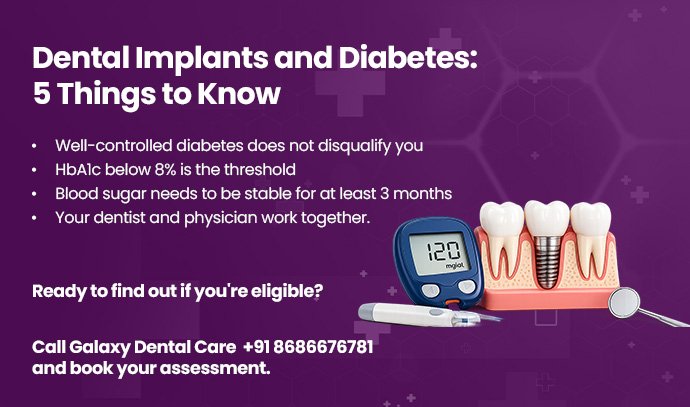
Diabetes doesn’t disqualify you from dental implants. Uncontrolled blood sugar does. The key number is HbA1c. It’s a blood test that shows your average blood sugar level over the past 2 to 3 months. It’s the number both your physician and your dentist use to decide whether dental implants cost safe for diabetics.
Research consistently shows that patients with an HbA1c below 8% have implant outcomes close to those of non-diabetic patients. Above 8%, complications rise sharply.
HbA1c Level
What Does It Means for Implants?
Below 7%
Well-controlled. Good candidate for implants with standard precautions.
7% to 8%
Acceptable range. Implants possible with careful pre-surgical planning.
Above 8%
Poorly controlled. Higher risk of delayed healing, bone loss, and implant failure. Stabilisation needed first.
Above 10%
High risk. Most clinicians recommend delaying implant surgery until blood sugar is stable.
One thing worth saying clearly: this isn’t about excluding diabetic patients. It’s about timing. Many patients who aren’t ready today can proceed after a few months of better glycemic control.
How Diabetes Affects Implant Healing?
When blood sugar is high for long periods, two things happen that directly affect implants.
First, healing slows down. High glucose levels reduce the body’s ability to form new tissue and fight bacteria. After implant surgery, the area needs to heal cleanly around the titanium post. In poorly controlled diabetics, that healing is slower and more prone to infection.
Second, osseointegration is affected. Osseointegration is the process where the jawbone gradually fuses around the implant post. That fusion is what holds the implant permanently in place. High blood sugar interferes with bone cell activity, which means the fusion takes longer and may not be as strong.
There’s also a higher risk of peri-implantitis. This is an infection that develops in the gum and bone around the implant after placement. Diabetic patients are more prone to gum infections generally, and this risk carries over to implant sites.
What the Dentist Checks Before Placing Implants in a Diabetic Patient?
A standard dental implants in Hyderabad assessment looks at bone condition, gum health, and the position of the missing tooth. For a diabetic patient, three more things get added to that list.
Current HbA1c reading. The dentist will ask for a recent HbA1c result, ideally from the last 3 months. If it isn’t available, a blood test is arranged before the consultation moves forward.
For diabetic patients, the implantologist and treating physician work together. The physician confirms whether blood sugar is stable enough for surgery and whether any medications need to be adjusted around the procedure.
The third piece is a CBCT scan of the jawbone. Diabetics who’ve had uncontrolled blood sugar for years sometimes show early bone loss in the jaw. A CBCT scan is a 3D image of the jawbone. It shows bone volume, density, and surrounding tissue condition. This tells the implantologist exactly where the implant can be placed safely.
On the day of surgery, blood sugar is monitored before the procedure begins. Most clinicians for diabetes and implantology aim for a fasting glucose reading below 180 mg/dL before proceeding. Antibiotics are often prescribed before and after placement for diabetic patients to reduce infection risk during healing.
Who Can Go Ahead: and Who Needs to Wait?
Most diabetic patients can get dental implants. The question is whether now is the right time. Patients who can typically proceed:
HbA1c is below 8% and has been stable for at least 3 months
Gum disease, if present, has been treated and controlled
The treating physician has confirmed the patient is medically stable for surgery
The patient doesn’t smoke, or is willing to stop before and after surgery
CBCT scan shows adequate bone for implant placement
Patients who should stabilise first:
HbA1c is between 8% and 10%. Blood sugar needs to come down before surgery.
Active gum disease or infection around the implant site is present
A recent spike in blood sugar levels that hasn’t settled yet
Medications have recently changed and the effect on blood sugar isn’t yet known
The only way to know which category applies to you is a proper assessment. Not a phone call. Not an online form. A clinical examination for the best dental implants in Hyderabad with your HbA1c result in hand.
Book a Consultation at Galaxy Dental Care, Hyderabad.
If you have diabetes and are considering dental implants treatment in Hyderabad, the right starting point is a proper clinical assessment. Diabetes and implantology work well together when the preparation is right.
At Galaxy Dental Care, Dr. Sudhakar Rao Malapati, MDS, Oral and Maxillofacial Surgeon, leads implant assessment and surgical planning across 9 Hyderabad branches. Every diabetic implant case begins with a review of your HbA1c and a CBCT scan. The physician is brought in before any decision is made.
Branches are open Monday to Sunday, 9 AM to 9 PM.
Call +91 8686676781 to book your dental implant near me.
Frequently Asked Questions
Can diabetic patients get dental implants in Hyderabad?
Yes. Diabetic patients with well-controlled blood sugar, meaning HbA1c below 8%, can get dental implants with outcomes close to non-diabetic patients.
What HbA1c level is needed before implant surgery?
Most implant clinicians work to an HbA1c below 8% before proceeding. Below 7% is ideal. Between 8% and 10%, the dentist near me and physician assess together whether to proceed with precautions or wait for better control.
Does diabetes slow down implant healing?
Poorly controlled diabetes does. High blood sugar slows tissue repair, affects how the bone fuses around the implant, and raises infection risk. Well-controlled diabetes has minimal impact on healing.
What precautions does the dentist take for diabetic implant patients?
Blood sugar is checked before surgery begins. Antibiotics are prescribed before and after placement to reduce infection risk. The procedure is planned around your physician’s clearance. Follow-up visits are scheduled more frequently.