Author: drksrism@gmail.com

  • What Should You Do About a Wisdom Tooth Cavity

    What Should You Do About a Wisdom Tooth Cavity

    The back tooth pain can be confusing, it feels like a mild pinch while chewing or food getting trapped at the very end of your jaw. Some people also notice a bad taste near the back gum. 

    To get over it you either treat a wisdom tooth cavity early with a filling, or remove the tooth if the decay is deep or the tooth is hard to clean. The right choice depends on your X-ray and the wisdom tooth position.

    At Galaxy Dental Care, we do not guess. Dentists take an X-ray, and explain your options clearly before proceeding. This blog will tell you what to do, when not to delay, and how to avoid complications, especially if you are searching for wisdom teeth removal near me or planning wisdom tooth extraction in Hyderabad.

    How Do You Know if a Wisdom Tooth Cavity is Mild or Serious?

    Wisdom tooth cavity is mild when it is small and accessible, and serious when you have strong pain, swelling, or any infection signs. The difference is not about how much it hurts, but what is happening under the gum.

    What you notice Mild Wisdom Tooth Cavity Signs Serious Wisdom Tooth Cavity Signs
    Pain pattern Mild pain only while chewing Pain lingers even after you stop eating
    Swelling No swelling Swelling near back gum or cheek
    Taste and smell No bad taste or pus Bad taste, foul smell, or pus-like discharge
    Food trapping Food gets stuck sometimes Food trapping with repeated inflammation
    Mouth opening Normal Difficulty opening the mouth fully
    What it usually means Early decay, often easier Wisdom Tooth Cavity Treatment Advanced decay or infection risk
    What to do now Book a check soon, avoid chewing there Book urgently, do not delay evaluation

    What Should You Do First When You Suspect a Wisdom Tooth Cavity?

    First, book a dental exam and X-ray for clear guidance. Avoid chewing on that side, keep the area clean, and do not self-medicate with antibiotics. Antibiotics do not cure cavities. They only control infection temporarily. 

    Can a Wisdom Tooth Cavity Be Filled and Saved?

    Yes, a wisdom tooth cavity can be filled if the tooth is fully erupted or the cavity is shallow. A filling works best when:

    • The wisdom tooth has erupted enough to reach easily
    • The decay is small to moderate
    • The tooth sits straight, not tilted
    • There is no repeated gum infection around the tooth

    If these conditions are met, wisdom tooth cavity treatment can be conservative, and saving the tooth may be reasonable.
    when does a wisdom tooth cavity

    When Does a Wisdom Tooth Cavity Need A Root Canal Or Removal?

    Deep decay near the nerve may need a root canal in some cases, but removal is often better when access is poor or infection keeps repeating. Here is a quick comparison of both the process:

    What you notice Mild Wisdom Tooth Cavity Signs Serious Wisdom Tooth Cavity Signs
    Pain pattern Mild pain only while chewing Pain lingers even after you stop eating
    Swelling No swelling Swelling near back gum or cheek
    Taste and smell No bad taste or pus Bad taste, foul smell, or pus-like discharge
    Food trapping Food gets stuck sometimes Food trapping with repeated inflammation
    Mouth opening Normal Difficulty opening the mouth fully
    What it usually means Early decay, often easier Wisdom Tooth Cavity Treatment Advanced decay or infection risk
    What to do now Book a check soon, avoid chewing there Book urgently, do not delay evaluation


    If your goal is long-term peace, wisdom tooth removal in Hyderabad is the cleanest solution.

    What Happens if You Ignore a Wisdom Tooth Cavity?

    If you ignore a wisdom tooth cavity, there are high chances decay can spread to the gum, jawbone, and the tooth in front, leading to swelling and emergency treatment.

    Ignoring it often turns a manageable wisdom tooth cavity treatment into an urgent infection visit.

    What Does Treatment For a Wisdom Tooth Cavity Look Like at the Clinic?

    Treatment for wisdom tooth cavity starts with an exam and X-ray, then the filling, root canal, or extraction is confirmed based on tooth position and decay depth. Step-by-step patient experiences are:

    • Check symptoms and examine the tooth, gum health
    • Take an X-ray to see decay depth and tooth angle
    • Explain options clearly: filling, RCT in select cases, or removal
    • Treat infection first if swelling or pus is present
    • Do the procedure with proper numbing and pain control
    • Give after-care instructions so healing stays smooth
    • Schedule follow-up if needed

    How Can You Prevent Cavities In Wisdom Teeth In The Future?

    Prevention is mostly about access and routine. Following steps can be followed to prevent wisdom tooth cavities

    • Use a small-head brush to reach the back molars
    • Angle the brush toward the gumline behind the last tooth
    • Floss the second molar properly, especially the back side
    • Rinse after sticky meals if brushing is not possible
    • Get regular dental checkups so early decay is caught
    • If the wisdom tooth is repeatedly inflamed, discuss early removal

    Many future problems are prevented when we remove a poorly positioned wisdom tooth before it destroys the tooth in front.

    Schedule a Visit with the Best Dentist at Galaxy Dental Care

    As soon as you notice back tooth pain, food trapping, a bad taste, or swelling, you should visit the best dental clinic in Kondapur because early care keeps a wisdom tooth cavity simple to fix. 

    If the tooth is fully erupted and the decay is reachable, Galaxy Dental Care plans a wisdom tooth filling only when it has a real chance of lasting. If the tooth is tilted, hard to clean, or infection is likely to repeat, we recommend wisdom tooth extraction in Hyderabad as a planned, step-by-step procedure with proper numbing and clear after-care.

    Galaxy Dental Care helps you decide faster with:

    • Clear diagnosis: clinical exam plus X-ray review before treatment decisions
    • Straight talk, no confusion: you know if saving the tooth makes sense or removal is the smarter long-term choice
    • Comfort-focused approach: proper anesthesia, calm explanations, and after-care guidance you can actually follow
    • Easy follow-ups: multiple Hyderabad locations so you can pick what fits your routine

    Whether you need wisdom tooth cavity treatment with a wisdom tooth filling or a planned wisdom tooth extraction in Hyderabad, we will guide you with clarity from day one. Call/WhatsApp: +91 8686676781
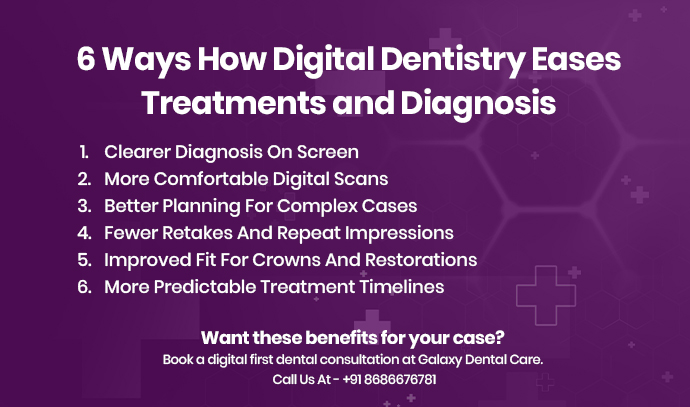
  • What is Digital Dentistry and How It Can Ease Treatments and Diagnosis

    What is Digital Dentistry and How It Can Ease Treatments and Diagnosis

    A lot of patients walk with confusion over understanding what is really happening before I spend money or  I do not want messy impressions again. If that sounds like you, you are not asking for anything extra. You are asking for clarity. That is exactly what digital dentistry is built for.

    Digital dentistry is not a trend. It is a smarter way to diagnose, plan, and deliver treatment using digital scans, 3D imaging, and computer guided workflows. When used correctly, digital dentistry eases treatments and diagnosis because it reduces guesswork, improves precision, and helps you see what the dentist sees.

    At Galaxy Dental Care, we use modern diagnostics and planning tools to make treatment simpler for patients. We have multiple branches across Hyderabad, so follow ups feel easy. If you are searching for a dental clinic near me or comparing options for the best dentist in Hyderabad, this blog will help you understand what digital dentistry actually changes for you.

    Understanding Digital Dentistry

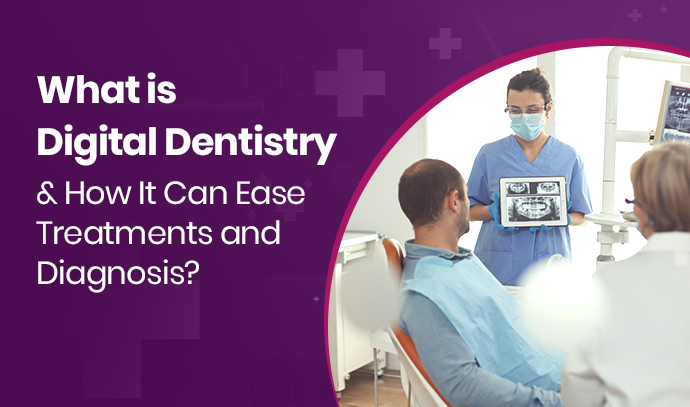
    Digital dentistry means using digital scans, images, and computer planning to diagnose and treat dental problems more accurately and comfortably. It replaces many old steps that felt messy, unclear, or time consuming.

    Many patients notice the difference immediately. You can see your teeth on a screen, understand what is happening faster and ask better questions. This is the reason digital dentistry eases treatments and diagnosis for common people.

    How Does Digital Dentistry Ease Dental Treatments and Diagnosis for Patients?

    Digital dentistry improves clarity, predictability, and comfort from the start. You get fewer surprises because plans are made with better information. Here is what patients usually feel:

    • Clearer diagnosis: digital images make it easier to spot the real issue
    • Better explanation: you see the problem, not only hear about it
    • Fewer retakes: digital impressions reduce the chances of repeat steps
    • Better planning: complex cases become safer when planned in 3D
    • More confidence: you understand your options before treatment begins

    This technique makes your care feel more guided with less trial and error.

    key digital dentistry

    Key Digital Dentistry Tools and Technologies

    The key tools in digital dentistry help dentists capture accurate information, design solutions, and deliver treatment with better fit and control. You do not need to remember every tool name. You only need to know what it does for you.

    1) Digital X-Rays

    Digital X rays give quick images with clear detail. They help us diagnose cavities, infections, bone changes, and more.

    2) OPG

    OPG gives a full mouth view. It helps us see teeth, jawbone, and overall structure in one image and supports smarter treatment planning.

    3) CBCT 3D scan

    CBCT shows 3D anatomy. It is useful when we need to check bone volume, nerves, sinus areas, or plan implants safely. 

    4) Intraoral scanner

    This tool creates a 3D model of your teeth. It often replaces old impression trays. Patients like it because it feels cleaner and more comfortable.

    5) Digital design and planning

    Computer planning helps us design restorations and plan steps more accurately. It also helps us explain the plan clearly.

    6) Guided workflows for complex procedures

    For treatments like implants or aligners, digital planning can guide the procedure step by step. 

    Thus, these tools support real world applications of digital dentistry.

    What are the Most Common Applications of Digital Dentistry in Everyday Dental Care?

    The most common applications of digital dentistry include diagnosis, crowns and bridges, implants, aligners, and smile planning. 

    You do not need a big makeover to benefit from it. The real value comes when these applications are used to make your case clearer and safer.

    Does Digital Dentistry Reduce Treatment Time, Visits, Or Discomfort?

    Digital dentistry often reduces chair time, avoids repeat steps, and makes planning faster, but the exact benefit depends on the treatment,correct diagnosis and good clinical execution. It does not make dentistry magical but smoother.

    Book Your Appointment at the Best Dental Clinics, Equipped With All the Advanced Dentistry Tools and Technologies! 

    If you want digital first diagnosis support, clear explanations, and branch convenience across Hyderabad choose Galaxy Dental Care. We focus on planning with modern diagnostics and explaining the plan in simple words. We also have multiple locations, which is a big advantage when you are searching for a dental clinic in Manikonda or dental clinic in AS Rao Nagar and want consistent follow ups.

    • Call Us At: +91 8686676781
    • Timings: 9:00 AM to 9:00 PM, Monday to Sunday
  • How To Maintain Dental Hygiene With Aligners?

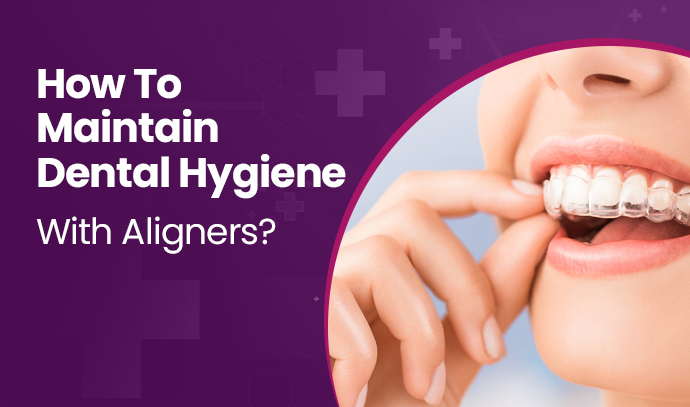
    How To Maintain Dental Hygiene With Aligners?

    Wearing aligners often comes with new questions. Many people struggle with bad breath, stains, cavities, or gum discomfort once treatment starts, especially with busy workdays, frequent snacking, or tea and coffee habits. This confusion is usually why people search about dental hygiene with aligners.

    Here is the direct answer to the title. You can maintain good dental hygiene with aligners by following a simple daily routine that keeps both your teeth and aligners clean. When hygiene is managed correctly, issues like odour, staining, and decay are easy to prevent.

    At Galaxy Dental Care, the best dental hospital in Hyderabad, we guide patients step by step through aligner care, not just aligner fitting. This blog explains invisible aligners and oral hygiene, practical aligner cleaning habits, and when to visit a dentist in Hyderabad during aligner treatment.

    What Is The Biggest Dental Hygiene Mistake People Make With Aligners?

    The most common mistake is wearing aligners again without cleaning the teeth after eating.

    Food particles and sugars get trapped between the aligner and teeth. This creates a closed space where bacteria multiply quickly. Over time, this increases the risk of cavities, gum swelling, and bad breath. Good dental hygiene with aligners always starts with cleaning your mouth before putting aligners back in.

    How Should You Clean Aligners Daily Without Damaging Them?

    Aligners need gentle daily care to stay clear and safe. Follow these steps for proper aligner cleaning:

    • Rinse aligners with normal water every time you remove them. 
    • Brush them lightly using a soft toothbrush. 
    • Use a clear, non-abrasive liquid cleanser if advised by your dentist. 
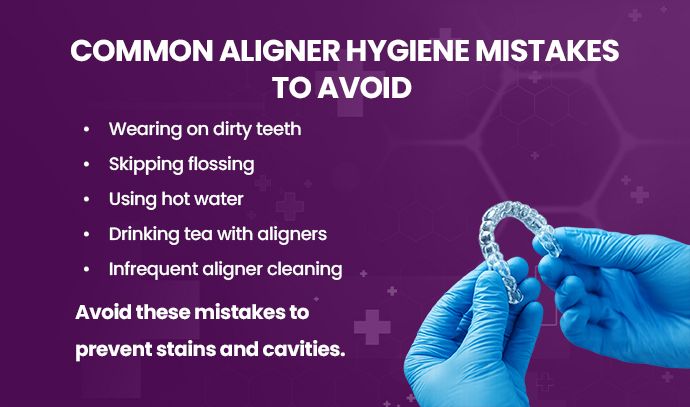
    • Never use hot water, as it can change the aligner’s shape. 

    This aligner cleaning routine prevents cloudiness and bacterial buildup.

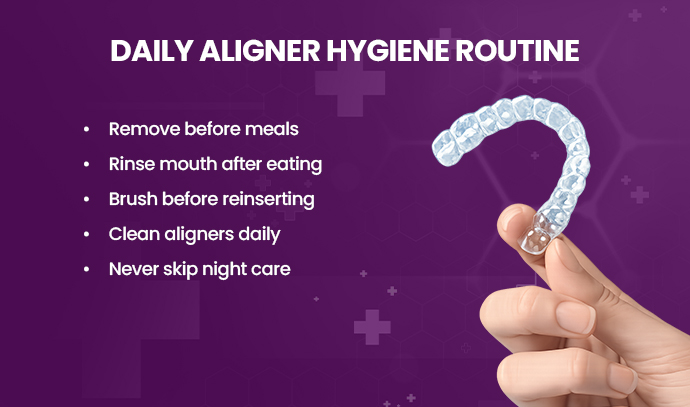
    daily aligner hygiene routine

    What Should You Do After Every Meal When Wearing Aligners?

    Your mouth should be cleaned before aligners go back in after eating. The safest aligner and oral hygiene routine is:

    • Remove aligners before meals. 
    • Rinse your mouth with water. 
    • Brush if possible, or floss and rinse well
    • Reinsert aligners only after teeth feel clean. 

    Skipping this step is one of the main reasons people develop hygiene issues during treatment.

    Which Foods And Drinks Increase Staining And Plaque With Aligners?

    Certain foods and drinks raise the risk of staining and plaque when aligners are involved.

    Be careful with:

    • Tea and coffee. 
    • Sugary drinks and juices. 
    • Coloured sauces. 
    • Sticky snacks. 

    If you consume these, remove aligners first and rinse your mouth well before wearing them again. This protects both your teeth and aligners.

    common aligner hygiene mistakes to avoid

    How Do You Brush And Floss Properly With Attachments And Aligners?

    Attachments need a little extra attention, but hygiene is still simple. To maintain invisible aligners & oral hygiene:

    • Use a soft toothbrush and clean carefully around attachments. 
    • Floss once daily to remove food between teeth. 
    • Clean gently along the gumline. 

    All these brushing and flossing tips with aligners prevents plaque buildup and reduces gum irritation during treatment.

    What Is A Simple Morning To Night Routine For Aligner Hygiene?

    A fixed routine makes hygiene easy, even on busy days.

    Morning

    • Brush teeth and clean aligners before wearing. .

    During the day

    • Remove aligners before meals. 
    • Rinse and clean teeth after eating. 

    Night

    • Brush and floss thoroughly. 
    • Clean aligners before final wear. 

    This morning, day and night routine supports long-term dental hygiene with aligners and keeps treatment smooth.

    How Can You Prevent Bad Breath While Wearing Aligners?

    Bad breath usually comes from trapped food or poor cleaning habits.

    To prevent it:

    • Never wear aligners on unclean teeth. 
    • Clean aligners daily. 
    • Drink enough water to avoid dryness. 
    • Do not skip flossing. 

    Consistent dental hygiene with aligners keeps breath fresh throughout aligner treatment.

    What Should You Do If Your Aligner Smells, Looks Cloudy, Or Has Stains?

    Cloudiness or odour usually means bacteria buildup.

    Take these steps:

    • Clean aligners thoroughly. 
    • Review your daily hygiene routine. 
    • Avoid coloured drinks with aligners. 

    If the issue continues, visit a dentist in Hyderabad to assess both the aligners and your oral hygiene.

    Get Invisible Aligners In Hyderabad With Proper Hygiene Support

    Aligner treatment works best when it is guided by a dental team that focuses equally on results and hygiene. Good daily habits, regular reviews, and clear instructions help prevent stains, cavities, and gum issues during treatment.

    At Galaxy Dental Care, patients receive best invisible aligners in Hyderabad along with step-by-step hygiene guidance and follow-up support. Our team explains how to maintain dental hygiene with aligners in everyday situations like office hours, travel, and social events, so treatment stays smooth and stress free.

    Book Your Aligners Consultation at the Best Dental Clinic in Hyderabad 

    If you are exploring invisible aligners in Hyderabad or searching for invisible aligners near me, choosing a clinic that prioritises oral hygiene throughout treatment helps protect your teeth while achieving the alignment you want.

    If you would like help with aligner cleaning, invisible aligners and oral hygiene, or a routine check during treatment, you can book an aligner hygiene review with our team at Galaxy Dental Care. 

    • Call Us At: +91 8686676781
    • Timings: 9:00 AM to 9:00 PM, Monday to Sunday
  • Early Childhood Cavities: Prevention And Treatment

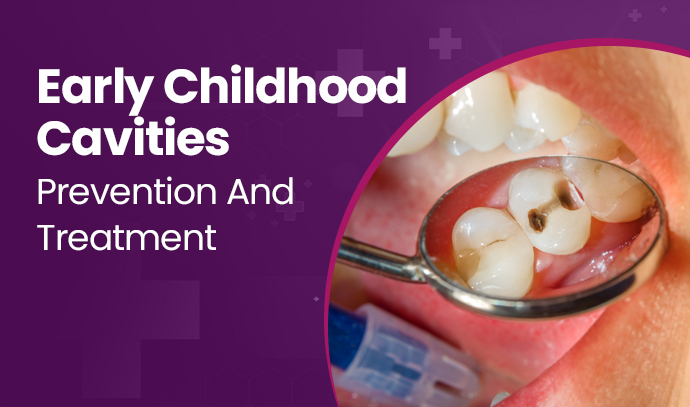
    Early Childhood Cavities: Prevention And Treatment

    As a parent, it is scary to see spots on your child’s teeth. It also gets challenging when your child cries during brushing or eating. Many parents worry they missed something and are usually concerned about early childhood cavities. 

    Here is the direct answer. Tooth decay in young kids is common, but it is also preventable in many cases. When you act early, dental care is usually simpler and gentler.

    At Galaxy Dental Care, a best pediatric dental clinic in Hyderabad for many families, our pediatric dentist in Hyderabad helps parents with clear, calm guidance on early childhood cavities. This blog covers early childhood prevention steps, early signs for cavities in children, safe treatment steps and the right time to book your appointment with a pediatric dentist near me. 

    What Causes Tooth Decay In Babies And Toddlers?

    Tooth decay can start soon after the first tooth comes in because baby teeth are softer and daily habits are still forming. Baby teeth have a thinner outer layer. Plaque can build up fast if teeth are not cleaned well. Bacteria then make acids that weaken the tooth surface.

    What Early Signs Show Cavities In Children?

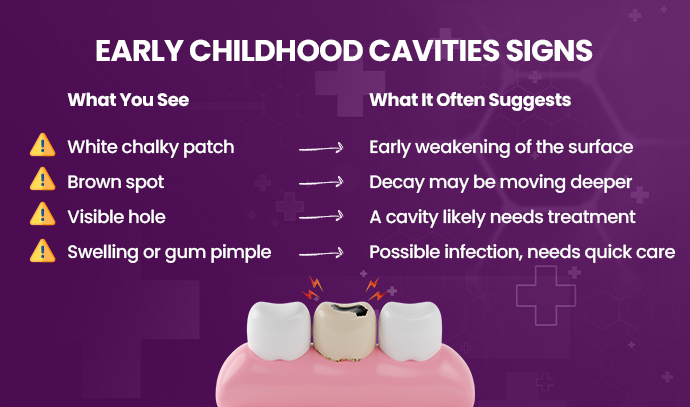
    Early signs for cavities in children often show on the tooth before your child can explain pain. So, what you notice matters. Common signs for cavities in children include:

    • White chalky patches near the gums,
    • Brown or dark spots on teeth,
    • Crying or refusing brushing,
    • Pain while chewing,
    • Bad breath that comes back soon.

    White spots can sometimes be reversed or managed with professional care. Brown spots often need a dentist to check for active decay. If you notice any white or brown spots on your child’s teeth, booking an appointment with the best pediatric dentist in Hyderabad is a safe option.

    Do Cavities In Children Matter If They Are Only In Baby Teeth?

    Yes. Cavities in children can still cause pain and poor sleep. They can also affect eating and speech. Baby teeth hold space for adult teeth. If a baby tooth is lost early, teeth can shift. This can raise the risk of crowding later.

    If you notice any signs of cavities in children, do not delay the treatment. Schedule your appointment with the pediatric dentist near me in Hyderabad. 

    How Fast Can Tooth Decay Worsen In Young Kids?

    In young kids, decay can move fast because baby teeth are smaller and the enamel is thinner. A small spot can become a deeper cavity within weeks or a few months. This is more likely if sweet drinks are frequent and the bedtime brush is missed.

    What Does Early Childhood Prevention Look Like At Each Age?

    Early childhood prevention works best when it matches your child’s age and routine.

    What Should Parents Do From 6 Months To 2 Years?

    • Wipe gums after feeds
    • Start brushing when the first tooth erupts
    • Avoid sleeping with milk in the mouth
    • Avoid sweet pacifiers, honey, or jaggery on dummies

    Night feeding after teeth erupt is a common trigger for early decay.

    What Should Parents Do From 2 Years To 5 Years?

    • Brush twice a day, especially before bed
    • Use a rice grain sized smear of fluoride toothpaste
    • Keep snacks at set times
    • Limit biscuits, sweets, and juice between meals

    Less sugar exposure across the day reduces risk.

    What Should Parents Do From 5 Years To 8 Years?

    • Supervise brushing and correct technique
    • Encourage water rinsing after meals
    • Keep routine dental checks

    Some children may benefit from protective sealants on back teeth. 

    Whether you’re a parent of a toddler or a teen, booking an appointment at the best pediatric dental clinic in Hyderabad will help you find the best treatment for cavities in children or early childhood cavities. 

    Which Habits Raise The Risk Of Early Tooth Decay?

    Tooth decay often comes from small habit gaps, not poor parenting. Higher risk habits include:

    • Frequent snacking
    • Sticky foods that stay on teeth
    • Sweetened milk, juice, or flavoured drinks
    • Night feeding after teeth erupt
    • Skipping the bedtime brush
    • Mouth breathing that dries the mouth

    If your child has sweets, keep them with meals. Then rinse with water. Do not skip the bedtime brush. For more such pediatric dental tips, do not miss your appointment with pediatric dentist in Hyderabad

    early childhood prevention

    When Should Parents Visit A Pediatric Dentist?

    A child should see a dentist by age one. Another good rule is within six months of the first tooth. Go sooner if you see spots, pain, or brushing trouble.

    Whether you’re searching for a pediatric dental clinic near me, or looking for an experienced pediatric dentist near me, your search ends with Galaxy Dental Care. Our experienced pediatric dentist in Hyderabad understands child behaviour and fear. We keep visits calm and child friendly. Our pediatric dentist in Hyderabad explains what is normal for your child’s age. We also tell you what needs care now and what can be watched.

    What Are Safe Treatment Options For Tooth Decay In Young Children?

    Treatment depends on the stage of decay. At Galaxy Dental Care, the goal is comfort and safety.

    What Parents Notice What We May Do
    White spots Improve home care, add protective care if needed
    Brown spots Stop progression with early treatment planning
    Visible cavity A filling to restore the tooth
    Weak tooth A child sized crown for protection
    Swelling or repeated pain Same day check to rule out infection


    For higher risk children, fluoride varnish can help when used with good daily habits. Our pediatric dentist in Hyderabad keeps visits short and calm. We explain each step in simple words.

    Book A Child Friendly Visit At Galaxy Dental Care

    Early childhood cavities can feel worrying, but most cases are manageable when you act early. If you want a clear plan for early childhood prevention, we can help.

    Offering all-in-one dental treatments under one roof with modern technology and personalised approach, we are the one-stop solution for all dental needs. Located at Kondapur, Kukatpally, Banjara Hills, Chandanagar, Nallagandla, Kompally and Manikonda, we ensure children, adults, and families receive timely care close to home, with clear guidance at every step.

    Call our pediatric dentists now at +91-8686676781 to book your appointment today.

  • Things You Should Know Before Going Through The Root Canal Procedure

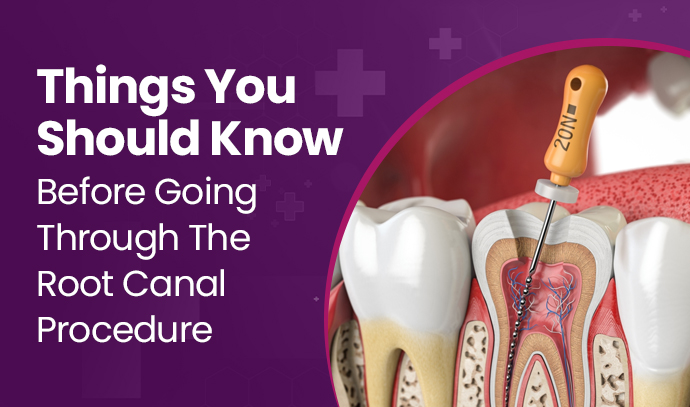
    Things You Should Know Before Going Through The Root Canal Procedure

    Is tooth pain keeping you awake? Has a dentist advised a root canal, and now you feel nervous about what will happen? Most people ask the same questions: Will the root canal procedure hurt? How long will it take? What should you do before you come in? What will you feel after it is done? Who offers the best root canal near me? 

    Here is the clear answer. Before you go through a root canal procedure, you should know how the dentist controls pain, what steps the dentist follows, how long the visit usually takes, and what normal root canal recovery time looks like. When you know these points in advance, you walk in calmer and avoid last minute surprises.

    In this blog, our expert dentists at Galaxy Dental Care answer the most common worries patients have before a root canal. Read through this blog to get clarity and confidence, and book an appointment for painless root canal treatment in Hyderabad ​with our experienced team when you are ready.

    What Are The Most Important Things To Know Before A Root Canal Procedure?

    You feel less stressed when you know what the dentist will do and what you will feel. These are the most important things to know before the root canal procedure.

    • The dentist numbs the tooth, so you should not feel sharp pain.
    • The numbness usually starts in about 10 minutes.
    • The dentist places a rubber dam to keep the tooth clean and dry.
    • The dentist usually completes the treatment in 45 to 90 minutes.
    • The dentist often finishes many cases in one sitting.
    • You usually feel pressure or mild vibration, not pain.
    • You may feel mild soreness after the numbness wears off.
    • The dentist often advises a crown later to prevent the tooth from cracking.

    Tell the dentist about diabetes, blood pressure, allergies, medicines, or strong anxiety before starting. This helps the dentist plan your comfort and safety.

    How Can You Tell If You Really Need A Root Canal Procedure?

    The dentist recommends RCT when infection reaches the nerve inside the tooth and the tooth cannot heal on its own. The dentist confirms this with an exam and an X-ray.

    These signs often point to the need for RCT.

    • You feel pain that keeps coming back, especially at night.
    • You feel hot or cold sensitivity that lasts longer than a few seconds.
    • You feel pain when you bite down.
    • You notice swelling or tenderness near the tooth.
    • You see a darker tooth after injury or deep decay.

    Treating the tooth early usually keeps the plan simpler and protects the tooth better.

    What Should You Do Before Coming In For A Root Canal Procedure?

    You prepare best when you keep your body comfortable and your mind calm. These steps support a smoother visit and help the dentist treat the tooth without delays.

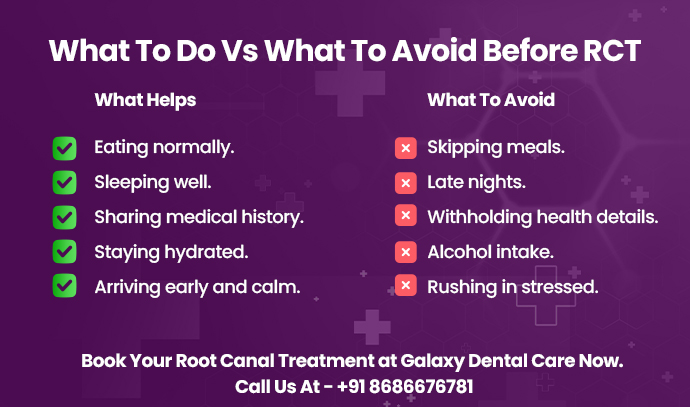
    Do these simple things before your appointment.

    • Get a good night’s sleep.
    • Eat a normal meal unless the dentist plans sedation.
    • Drink water and stay hydrated.
    • Avoid alcohol before the visit.
    • Avoid tobacco on the day of treatment if possible.
    • Carry a list of your medicines.
    • Share medical conditions and allergies with the clinic.
    • Wear comfortable clothing and avoid tight neckwear.
    • Arrive a little early so you do not rush.
    • Arrange transport if you feel very anxious or expect sedation.

    What Should You Tell The Dentist Before The Root Canal Procedure Starts?

    You help the dentist plan safer care when you share your health details upfront. This avoids surprises during treatment.

    Tell the dentist if any of these apply.

    • You have diabetes, blood pressure issues, or heart conditions.
    • You take blood thinners or long term medicines.
    • You have allergies to medicines or local anaesthesia.
    • You recently had fever, infection, or illness.
    • You are pregnant or recently had a medical procedure.
    • You feel strong dental anxiety or fear injections.
    • You notice pain that increases when you bite or lie down.

    If you feel very anxious, ask about comfort options before starting. This helps the dentist keep the procedure calm and controlled.

    root canal procedure

    How Long Does The Root Canal Procedure Take And Will It Be Completed In One Sitting?

    The dentist completes many cases in one sitting. The visit usually takes about 45 to 90 minutes. The dentist plans the time based on the tooth and infection level.

    These situations can make it take longer or need another visit.

    • The tooth has multiple canals or curved canals.
    • The infection runs deep or has lasted long.
    • The tooth needs re-treatment.
    • The dentist needs extra cleaning to control infection.

    The dentist explains the likely time and visit count before starting, so you know what to expect.

    What Should You Eat Or Avoid Before A Root Canal Procedure?

    Eat a normal meal before you come in, unless the dentist plans sedation and gives different instructions.

    Do this before the visit.

    • Eat a normal meal.
    • Drink water and stay hydrated.
    • Choose soft foods if the tooth feels very sensitive.

    Avoid this before the visit.

    • Avoid alcohol.
    • Avoid tobacco.
    • Avoid very hot foods if heat triggers pain.
    • Avoid chewing on the painful side.

    These steps support preparing for root canal treatment in a safe way.

    What Are Common Myths You Should Not Worry About Before A Root Canal Procedure?

    Old stories create fear. Modern dentistry changes the experience.

    Ignore these common RCT myths.

    • A root canal procedure always hurts. The dentist numbs the tooth first.
    • Extraction is always better. The dentist often saves the natural tooth for better function.
    • RCT always needs many visits. The dentist finishes many cases in one sitting.
    • Pain lasts for weeks. You may feel mild soreness, but severe pain is not expected.
    • The tooth becomes weak forever. The dentist protects it with a crown when needed.

    Choose a dental clinic that explains the plan clearly before starting. If you are searching for root canal treatment in Hyderabad, best root canal treatment in Hyderabad, or painless root canal treatment in Hyderabad, Galaxy Dental Care offers the best dental treatments. 

    Book Your Appointment For Root Canal Treatment In Hyderabad At Galaxy Dental Care Now!

    When tooth pain is involved, choosing the right clinic is about feeling confident and understood, not rushed. You should feel comfortable asking questions, knowing how pain will be managed, and understanding what happens before, during, and after the procedure.

    At Galaxy Dental Care, root canal treatment is planned with clarity and care. Dentists take time to explain why RCT is needed, how the procedure will be done, and what recovery usually looks like. The focus stays on saving the natural tooth, maintaining strict hygiene, and ensuring patient comfort at every step.

    If you are looking for root canal treatment in Hyderabad, painless root canal treatment in Hyderabad, or the best root canal treatment near you, booking an appointment at our dental clinic helps you get clear answers first and treatment only when you are ready.

    Call us now at +91 8686676781 to schedule your consultation for the best root canal treatment near me in Hyderabad. 

  • How do Dental Implants Work and What are Their Benefits?

    How do Dental Implants Work and What are Their Benefits?

    Missing a tooth often creates problems that go beyond appearance. Food may not chew evenly, speech can feel slightly off, and nearby teeth can start shifting into the gap. Over time, this can affect bite balance and jaw health. Many people hesitate because they are unsure how dental implants work, whether dental implant surgery is painful, or if the replacement will feel natural in daily life.

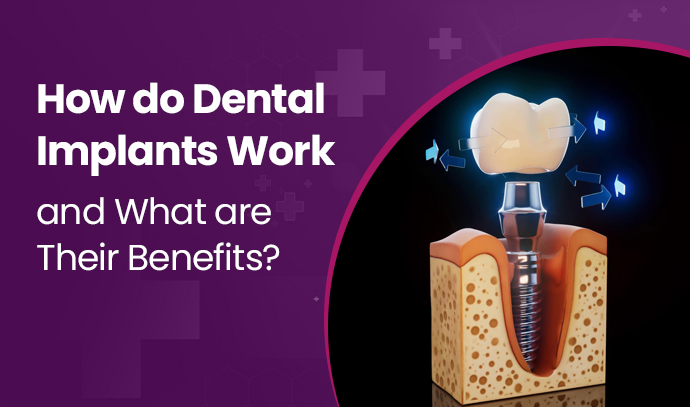
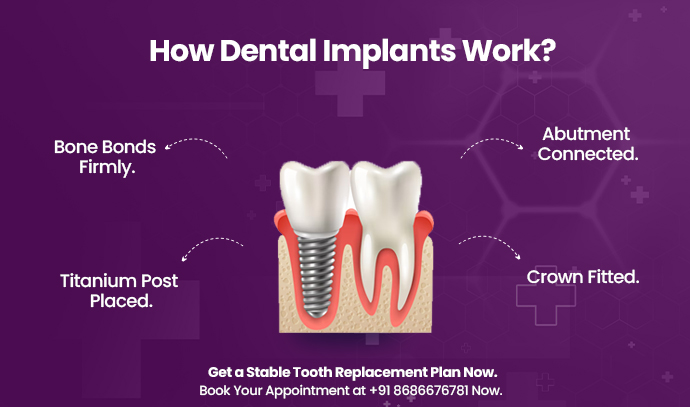
    The clear answer is this. Dental implants work by placing a titanium post into the jawbone, allowing it to bond with the bone, and then fixing a custom tooth on top to restore function and stability. This is why dental implants are considered a reliable solution for long term tooth replacement.

    At Galaxy Dental Care in Hyderabad, dental implant treatment is planned step by step, with clear explanations about suitability, healing, and aftercare. Read on to understand the process, dental implants benefits, and when to consider dental implants in Hyderabad.

    How Do Dental Implants Work Inside The Jawbone?

    Dental implants work by replacing the missing tooth root with a titanium implant post that sits inside the jawbone. After jawbone preparation, the implant is placed through surgical placement and allowed to heal. During osseointegration healing, the bone grows tightly around the implant, which is what gives implants their stability.

    dental implants work inside

    What Makes An Implant Stay Firm?

    • The titanium implant post is placed in the jawbone to act as a root.
    • The bone bonds to the implant during osseointegration healing.
    • The implant becomes stable enough to support a fixed tooth.

    What Happens During Dental Implant Surgery From Start To Finish?

    Dental implant surgery is usually done in planned stages so healing and fit are not rushed. The exact steps depend on bone support and the number of teeth being replaced, but the sequence stays clear.

    Dental Implant Surgery Stages 

    • Smile assessment to understand the missing tooth area and bite.
    • Jawbone preparation planning based on scans.
    • Surgical placement of the implant into the bone.
    • Healing time for osseointegration healing.
    • Abutment connection to link implant and tooth.
    • Custom crown fitting to restore the visible tooth and chewing surface.

    This is why dental implants treatment in Hyderabad should always be planned around bone and bite, not only around the gap.

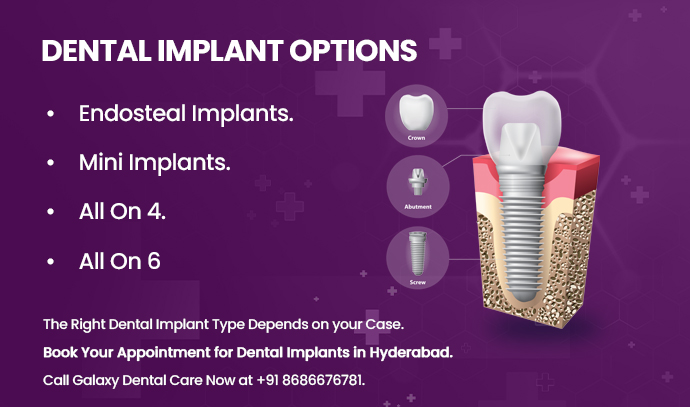
    Which Parts Make Up A Dental Implant And How Do They Work Together?

    A dental implant functions like a natural tooth because it is built in layers, with each part supporting the next. When these parts are placed and aligned correctly, the final tooth looks natural and handles daily chewing without strain.

    How Each Implant Component Supports The Final Result?

    • The titanium implant post acts as the artificial tooth root and anchors inside the jawbone.
    • The abutment connection sits above the implant and creates a secure link for the crown.
    • The custom crown fitting restores the visible tooth, shaped to match the bite.

    In cases where precision matters, custom milled abutments can be used to improve fit and long term comfort.

    What Types Of Dental Implants Are Used And Who Are They For?

    Different implant designs are used based on bone condition, jaw shape, and the kind of tooth loss. A quick online list does not help unless it also explains why a type is chosen.

    Common Implant Types And When They Are Considered?

    • Endosteal implants for most standard tooth replacement cases.
    • Subperiosteal design when bone height is limited and needs an alternative base.
    • Zygomatic implants for severe upper jaw bone loss in selected patients.
    • Mini dental implants when space is narrow or bone width is limited.
    • Basal implants for specific bone conditions where basal support is suitable.
    • All on 4 concept for full arch restoration in suitable cases.
    • All on 6 solution when extra full arch stability is needed.

    If someone is searching for the best dental implants in Hyderabad, the real difference is not the name of the implant, but whether the plan matches bone support and bite forces. Book your appointment with Galaxy Dental Care now to know which implant option is the best for you. 

    dental implant type

    What Can Dental Implants Replace In Single Tooth And Full Mouth Cases?

    Dental implants can replace one tooth, multiple teeth, or a complete set, depending on the case. This flexibility is why many people look for dental implant near me when they want a fixed option instead of removable teeth.

    Common Implant Solutions

    • Single tooth replacement without cutting adjacent teeth.
    • Multiple implant bridge when several teeth are missing in a row.
    • Full arch restoration for patients missing most or all teeth.
    • Immediate load implants in selected cases where stability allows early tooth fitting.

    What Are The Dental Implants Benefits That Matter For Daily Life?

    Dental implants benefits are not limited to appearance. The goal is a stable tooth that supports function and helps protect oral health.

    Dental Implants Benefits

    • Bone preservation by reducing jawbone shrinkage after tooth loss.
    • Natural appearance that blends with surrounding teeth.
    • Chewing restoration so food can be handled confidently.
    • Speech improvement by restoring stable bite contact.
    • No slipping dentures during eating or talking.
    • Adjacent teeth saved because they are not cut for support.
    • Long term durability when hygiene and follow ups are maintained.
    • Facial structure is maintained, which supports natural facial profile.
    • Confidence restored because the tooth feels fixed, not loose.

    For many patients looking for dental implants in Hyderabad, these are the benefits that make implants feel worth it.

    What Factors Decide Whether Dental Implant Treatment Will Succeed Long Term?

    A high success rate is achieved when planning and aftercare are taken seriously. Implant care continues even after the crown is placed.

    Success Factors That Protect The Implant Over Time

    • Bone density adequate to hold the implant securely.
    • Gum health optimal before placement and during follow ups.
    • Non smoker status, or reduced smoking during healing.
    • Diabetes controlled if present.
    • Oral hygiene maintained every day.
    • Loading protocol followed to avoid overload in early healing.
    • Peri implant health checked to prevent gum and bone problems.
    • Professional cleaning and regular checkups scheduled.
    • Night guard protection used if grinding is present.

    These factors strongly influence results, no matter where dental implants treatment in Hyderabad is done.

    Is Dental Implant Surgery Safe And How Long Can Dental Implants Last?

    Dental implant surgery is widely performed and considered safe when the case is planned correctly and follow ups are consistent. Many implants last for years and often decades, but longevity depends on bone support, gum care, and daily hygiene habits. A stable implant still needs regular checkups, just like natural teeth.

    When Should Dental Implants Treatment In Hyderabad Be Considered?

    Dental implants treatment in Hyderabad should be considered when a missing tooth affects chewing, speech, bite balance, or confidence. It is also worth considering when a denture feels loose or when a bridge would require cutting healthy teeth. 

    If searches include dental implants in Hyderabad, best dental implants in Hyderabad, dental implant near me, or dental implants treatment in Hyderabad, the next step should be an implant consultation to confirm bone support, implant type, and timeline.

    Book Your Dental Implants Consultation In Hyderabad At Galaxy Dental Care!

    When implants are done well, they feel stable and natural. That result depends on careful evaluation and planning, not just the procedure itself. At Galaxy Dental Care in Hyderabad, implant planning focuses on bone support, gum condition, bite forces, and a clear timeline for healing and crown placement.

    Call +91 8686676781 to book a consultation and get clear answers on suitability, expected steps, and long term care.

  • The Future of Orthodontics: Why Invisalign Is Revolutionising Smile Design?

    The Future of Orthodontics: Why Invisalign Is Revolutionising Smile Design?

    Many people want straighter teeth, but delay treatment because braces feel too visible, uncomfortable, or hard to manage daily. Adults worry about how braces look at work. Parents worry about food habits, hygiene, and comfort for teens. That is why people search about the future of orthodontics and whether Invisalign is truly better than braces.

    Here is the direct answer. Invisalign is changing smile design because it uses digital planning and clear aligners to move teeth in planned steps, without fixed wires. At Galaxy Dental Care in Hyderabad, our expert orthodontists use this approach to keep treatment clear, trackable, and practical for real life.

    Why Is Orthodontics Changing So Rapidly Today?

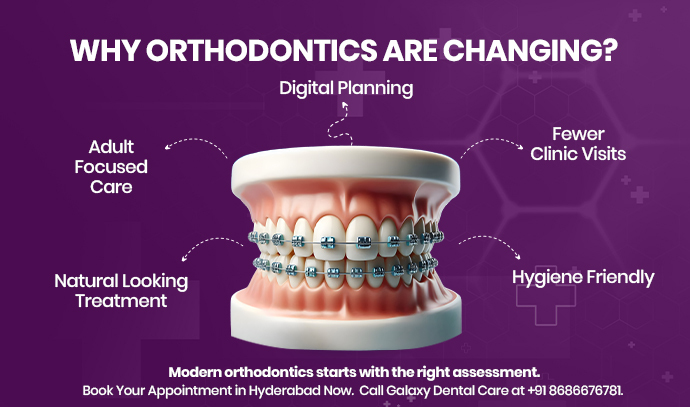
    Orthodontics is changing because patients now want straighter teeth with fewer lifestyle compromises. People want a solution that looks natural during conversations, supports easy cleaning, and reduces unplanned clinic visits. This is why the future of orthodontics is moving toward technology led planning and aligner systems.

    Future of Orthodontics: What Is Driving This Shift?

    • Adult orthodontics is rising because more adults want smile correction later in life.
    • Professional appearance matters more during treatment than it did earlier.
    • Patients want hygiene maintained with simpler routines.
    • Technology is improving predictability through digital planning tools.

    game changing advancement in orthodontics

    What Makes Invisalign A Game Changing Advancement In Orthodontics?

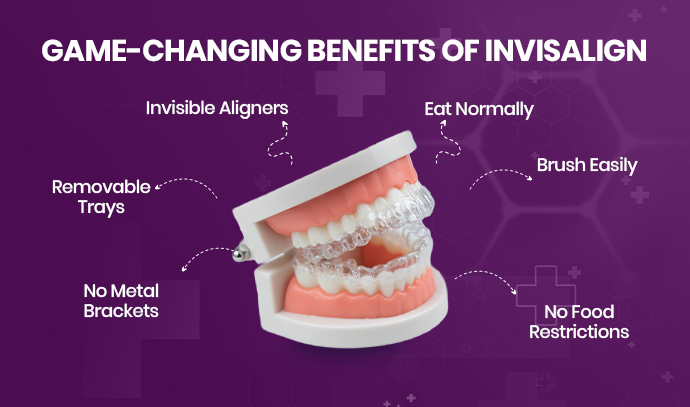
    Invisalign is a major upgrade because it replaces fixed braces with invisible aligners that are designed for your teeth and bite. These are removable trays, not a fixed appliance, which changes the daily experience.

    Game Changing Benefits Of Invisalign.

    • No metal brackets, so the mouth feels smoother during wear.
    • You can eat normally because trays are removed for meals.
    • You can brush easily because there are no wires to clean around.
    • There are no food restrictions because nothing is fixed to the teeth.

    These practical improvements are the real game changing benefits of Invisalign, not just “clear trays.” They are also a key reason Invisalign is transforming orthodontic treatment for both adults and teenagers.

    How Does Invisalign Technology Plan And Move Teeth So Precisely?

    Invisalign works because tooth movement is planned before you start, then executed step by step using a digital roadmap. This is where it differs from traditional braces adjustments.

    Invisalign Treatment Features That Make The Plan Predictable.

    • ClinCheck software creates the movement roadmap.
    • 3D treatment planning maps each stage clearly.
    • Virtual smile simulation previews the expected outcome early.
    • Digital scans iTero capture accurate records without impressions.
    • AI predictions support movement planning in suitable cases.
    • SmartTrack material helps deliver controlled force.
    • Sequential trays guide movement in small steps.
    • 14-day changes keep progress steady and measurable.
    • A remote monitoring app may be used in some plans for progress checks.

    This planning-first approach is one reason Invisalign is transforming orthodontic treatment into something more predictable for many patients.

    What Is The Invisalign Treatment Process From Start To Finish?

    Invisalign follows a structured clinical flow, so you always know what happens next and why.

    The Invisalign Treatment Process, Step By Step.

    • Smile assessment to review alignment, bite, and goals.
    • Intraoral scanning to create a digital model of your teeth.
    • Custom tray fabrication based on the approved plan.
    • Initial tray fitting with wear and care instructions.
    • Weekly progress checks at home to track fit and routine.
    • Chewies activation to help trays seat fully.
    • Attachment placement when extra grip is needed for movement.
    • IPR spacing when small space creation improves alignment.
    • Refinement scans if minor corrections are required.
    • Final positioning checks before moving to retention.

    This is Invisalign in practice, planned, controlled, and easy to follow.

    What Are The Real Day To Day Benefits Of Invisalign For Adults And Teens?

    Invisalign is popular because it fits into daily life with fewer disruptions. This matters for adult orthodontics and also for teen treatment when school schedules are packed.

    Patient Benefits You Can Actually Feel.

    • Shorter treatment time in suitable cases.
    • Fewer appointments compared to frequent brace adjustments.
    • Less discomfort for many patients during transitions.
    • No emergency visits for broken wires.
    • Predictable results when wear time is followed.
    • Speech unaffected for most people after a short adjustment period.
    • Sports safe because there are no sharp edges.
    • Travel friendly because you carry trays, not repair tools.
    • Hygiene maintained because cleaning is simpler.
    • Confidence boost because the aligners look natural.

    For teens, compliance indicators may be used in some plans to help track wear time.

    orthodontics changing

    How Does Invisalign Compare With Braces In Real Outcomes And Experience?

    Both options can straighten teeth, but the experience differs a lot. The right choice depends on your case complexity and routine.

    Braces vs Invisalign What It Means For You
    Metal wires eliminated. No wire tightening discomfort.
    Emergency breaks avoided. Fewer sudden repair visits.
    White spots prevented. Better cleaning access around teeth.
    Gum irritation free. Less rubbing from metal parts in many cases.
    Root resorption less. Controlled forces may reduce risk in some cases.
    Finishing precision. Digital planning can improve end detailing.
    Retention phase seamless. Vivera retainers can maintain alignment.

    This kind of clarity is what most people want when they search the game changing benefits of Invisalign versus braces.

    Who Is Invisalign Best Suited For Today?

    Invisalign works best when case selection is done correctly and the plan is followed consistently. Invisalign is often a strong fit for.

    • Adults who want smile correction that looks natural at work.
    • Teens who can follow wear time, with support when needed.
    • Patients who want a clear plan and fewer surprises.
    • People who prefer no metal brackets in the mouth.

    Some complex bite corrections may still need braces. A proper evaluation makes that clear quickly.

    Book Your Orthodontic Treatment In Hyderabad At Galaxy Dental Care Today!

    If alignment issues are affecting your confidence, cleaning, or bite comfort, do not rely on guesswork from online checklists. The next step is a smile assessment with an orthodontist, because suitability depends on your bite, spacing, and movement needs.

    If you are searching for an orthodontist in Hyderabad, the best orthodontist in Hyderabad, or an orthodontist near me, Galaxy Dental Care offers orthodontic evaluation and clear aligner planning, with direct contact support for appointments. 

    Call +91 8686676781 to book your appointment at any of our branches, located at Kondapur, Kukatpally, Banjara Hills, Chandanagar, Nallagandla, Kompally or Manionda. 

  • Teeth Whitening: Professional vs. At-Home Kits – What Works Best?

    Teeth Whitening: Professional vs. At-Home Kits – What Works Best?

    Introduction

    A bright, white smile can boost your confidence and make a lasting impression. With so many teeth whitening options available—from over-the-counter kits to professional treatments—it’s easy to get confused about which method is best for you.

    Types of Teeth Whitening

    1. Professional In-Office Whitening: This is performed by a dentist using stronger bleaching agents. The results are often immediate and can be up to several shades lighter after just one session.
    2. Professional Take-Home Kits: Dentists can provide custom-fitted trays and professional-grade whitening gels for patients to use at home over several days or weeks.
    3. Over-the-Counter (OTC) Products: These include strips, gels, and whitening toothpaste. They usually contain milder bleaching agents compared to professional options.

    Advantages of Professional Whitening

    • Safe and Controlled Environment: A dentist monitors your treatment to prevent damage to gums or tooth enamel.
    • Faster Results: Stronger whitening agents and specialized equipment yield quicker, more dramatic results.
    • Custom Approach: A dentist near me can tailor the process to your specific needs and make adjustments if you experience sensitivity.

    Common Pitfalls of At-Home Kits

    • Limited Strength: OTC products often don’t have the same concentration of bleaching agents, leading to slower or less noticeable results.
    • Potential Sensitivity: Misusing strips or generic trays can irritate your gums and increase tooth sensitivity.
    • Variability: Because everyone’s teeth are different, results can vary significantly with at-home methods.

    Maintaining Your White Smile

    • Avoid Staining Foods and Drinks: Coffee, tea, red wine, and berries can lead to discoloration. If you indulge, rinse or brush soon after.
    • Good Oral Hygiene: Regular brushing and flossing can help keep your teeth stain-free longer.
    • Regular Touch-ups: Over time, you may need occasional touch-ups with either professional treatments or at-home solutions to maintain brightness.

    Conclusion

    While at-home kits can be convenient and cost-effective, professional whitening offers the safest and most noticeable results. If you’re aiming for a significantly brighter smile or have stubborn stains, consider scheduling an in-office whitening session at Galaxy Dental Care.

  • Dental Implants vs. Bridges: The Best Option for Missing Teeth

    Dental Implants vs. Bridges: The Best Option for Missing Teeth

    Introduction


    Missing teeth can affect your confidence, chewing ability, and overall oral health. Two common ways to replace a lost tooth (or multiple teeth) are dental implants and dental bridges. Understanding the differences between these options can help you and your dentist decide which solution is best for you.

    Dental Implants: An Overview

    A dental implant is an artificial tooth root (often made of titanium) that is surgically placed into the jawbone.

    • Longevity and Stability: Implants fuse with the jawbone over time, providing a stable foundation for a crown.
    • Bone Preservation: Because they integrate with bone tissue, implants help prevent bone loss in the jaw.
    • Natural Look and Feel: Implants function much like natural teeth and don’t rely on neighboring teeth for support.

    Dental Bridges: An Overview

    A dental bridge is a restoration that “bridges” the gap left by a missing tooth. It typically consists of a false tooth (pontic) held in place by crowns on the adjacent teeth.

    • Less Invasive Placement: Bridges don’t require surgery. Instead, the neighboring teeth are prepared for crowns.
    • Faster Process: The procedure usually takes a couple of dental visits—significantly quicker than implant treatment.
    • Possible Drawback: Neighboring teeth need to be filed down to fit crowns, which may compromise otherwise healthy teeth.

    Pros and Cons

    Dental Implants

    • Pros: Durable, preserves jawbone, natural appearance.
    • Cons: Requires surgery, higher initial cost, longer treatment time.

    Dental Bridges

    • Pros: Less invasive, quicker procedure, can be more affordable initially.
    • Cons: Requires modification of adjacent teeth, may need replacement after several years.

    Which Option is Right for You?

    • Bone Density: Implants require sufficient jawbone to anchor the posts. If you have low bone density, you may need additional procedures like bone grafting.
    • Oral Health Status: A bridge might be more suitable if surrounding teeth already need crowns or have large fillings.
    • Budget and Time Frame: While implants can be more expensive and take longer, they often last longer and provide a more permanent solution. Bridges are typically quicker but may need replacement after 10-15 years.

    Conclusion

    Choosing between dental implants and bridges depends on various factors including your oral health, budget, and time constraints. Consult with your dentist at Galaxy Dental Care to determine which treatment aligns best with your needs and to restore your smile’s function and appearance.

  • Signs You Need a Root Canal: Don’t Ignore These Symptoms

    Signs You Need a Root Canal: Don’t Ignore These Symptoms

    Introduction


    Root canal therapy often has a scary reputation, but it’s actually a routine procedure that can save a damaged tooth. The earlier you catch signs of infection or nerve damage, the more likely you can avoid complications and severe pain. Knowing what symptoms to look for is the first step.

    What is a Root Canal?

    A root canal is a dental procedure that involves removing infected or inflamed pulp (the soft tissue inside the tooth), disinfecting the space, and then sealing it to prevent further infection. This saves the tooth from extraction and helps maintain the natural structure of your mouth.

    Common Symptoms Indicating You May Need a Root Canal

    1. Severe Toothache
      • Throbbing or persistent pain could indicate that the tooth’s pulp is infected or inflamed.
    2. Prolonged Sensitivity
      • If hot or cold foods cause lingering discomfort, it might signal nerve damage.
    3. Swollen or Tender Gums
      • Infection can spread beyond the tooth, causing inflammation in the surrounding gum tissue.
    4. Darkening of the Tooth
      • A tooth that is turning gray or black from the inside may have a dying nerve.
    5. Pimple on the Gums (Fistula)
      • A small, raised bump near the affected tooth can be an indication of an abscess or chronic infection.

    The Root Canal Procedure

    1. Assessment and X-Rays: Your dentist will examine the tooth and use X-rays to check the extent of the infection.
    2. Local Anesthesia: The tooth and surrounding area are numbed to ensure minimal discomfort.
    3. Cleaning the Canal: The dentist removes infected pulp and disinfects the canal.
    4. Filling and Sealing: A biocompatible material is used to fill the canal, and a filling or crown is placed to protect the tooth.

    Recovery and Aftercare

    • Mild Discomfort: You may experience slight tenderness after the procedure, which can usually be managed with over-the-counter pain relievers.
    • Oral Hygiene: Continue regular brushing, flossing, and using mouthwash to maintain dental health.
    • Follow-Up Appointment: Your dentist may schedule a check-up to ensure the tooth is healing properly.

    Conclusion

    If you notice any of these symptoms—especially persistent tooth pain or swelling—it’s crucial to consult a dentist. A root canal can relieve discomfort, prevent further complications, and save your natural tooth in the long run.