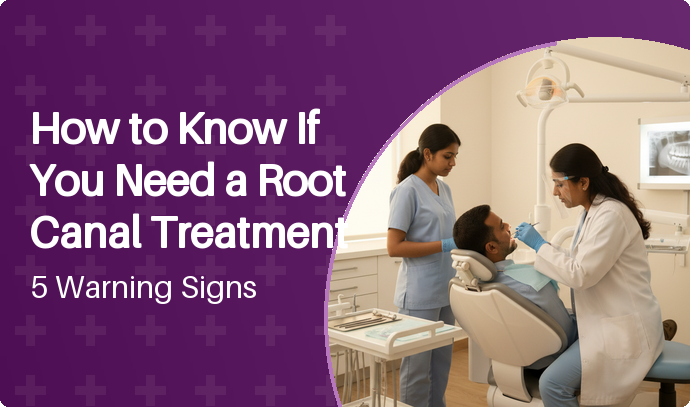
How to Know If You Need a Root Canal Treatment: 5 Warning Signs
by Galaxy Dental CarePublished : 10 October 2026
How to know if you need a root canal treatment is a question patients ask when a tooth hurts and does not settle. The clearest signs are pain that stays after hot or cold food, throbbing that wakes you at night, sharp pain when you bite, a pimple-like swelling on the gum, or a single tooth turning grey or brown. These mean the soft nerve tissue inside the tooth, called the pulp, may be infected or dying. Galaxy Dental Care checks this with cold tests, gentle tapping, and an OPG full-mouth X-ray or CBCT 3D scan to see inside the bone. Our endodontists and general dentists work together to confirm whether the tooth can be saved with Root Canal Treatment or needs a different approach. By the end of this article, you will know which symptoms mean you should book a consultation within 24 to 48 hours.
Key takeaways
Lingering pain after heat or cold that lasts more than 30 seconds suggests pulp inflammation needing prompt assessment.
Throbbing night pain that wakes you usually means the nerve is severely inflamed and unlikely to heal without treatment.
A gum boil or swelling near a tooth often signals a dental abscess, which can spread without root canal treatment.
Only clinical tests and X-rays can confirm the diagnosis; self-diagnosis by symptoms alone is not reliable.
A root canal treated tooth can last many years with a proper crown and regular check-ups.
What does a tooth needing a root canal treatment feel like?
A tooth needing Root Canal Treatment usually gives warning signs before the pain becomes constant. The most telling feeling is pain that lingers after you drink something hot or cold. Healthy teeth feel temperature for a few seconds. When the pulp inside is inflamed, that ache can last 30 seconds or more. Another common feeling is a dull throb that builds and does not respond to painkillers well. Some patients feel sharp, electric pain when they bite down or release pressure. This happens when the ligament around the tooth root is irritated by infection spreading from inside the tooth. A tooth that turns darker than its neighbours, especially after an injury, may also have a dying nerve. These signs are not proof on their own, but they are reasons to see a dentist within one to two days.
Which symptoms mean you should call a dentist quickly?
Certain symptoms need faster attention than others. Use this table to judge urgency.
Symptom
What it suggests
When to call
Pain lingering over 30 seconds after hot or cold
Inflamed or dying pulp
Within 24 to 48 hours
Throbbing pain that wakes you at night
Advanced pulp inflammation
Same day or next morning
Sharp pain on biting or releasing pressure
Infection at root tip irritating surrounding bone
Within 24 hours
Gum swelling or a pimple with pus
Dental abscess
Same day, especially with fever
Tooth turning grey or brown after trauma
Internal bleeding and nerve death
Within a few days, sooner if painful
A dental abscess is a pocket of infection that can spread to the face or jaw if left untreated. If you notice swelling with fever, difficulty swallowing, or spreading redness, seek emergency care. Galaxy Dental Care offers a 24/7 emergency phone line for such situations. Signs You Need a Root Canal: Don’t Ignore These Symptoms covers these warnings in more detail.
How does a dentist confirm you need a root canal treatment?
Symptoms guide the dentist, but tests confirm the diagnosis. At Galaxy Dental Care, the check starts with your description of the pain: where it is, what triggers it, how long it lasts, and what relieves it. The dentist then examines the tooth and surrounding gum. A small pimple on the gum, called a fistula, often points to a chronic abscess even when pain is mild. The dentist may tap the tooth gently with a metal instrument. Pain on tapping suggests inflammation around the root tip. A cold test checks if the nerve inside still responds. A tooth that feels nothing, or one that hurts long after the cold is removed, usually has pulp damage. Electric pulp testing gives a similar reading using a mild current. These chairside tests are paired with imaging. An OPG full-mouth X-ray shows the whole jaw and can reveal dark areas around root tips that indicate bone loss from infection. A CBCT 3D scan gives cross-sectional views of bone density, root shape, and how close nerves or sinuses lie. This matters for planning complex cases. The dentist also checks your medical history, current medicines, and conditions like diabetes that affect healing. Only after this full assessment is Root Canal Treatment recommended or ruled out.
What happens during root canal treatment?
Root canal treatment removes infected or dead pulp tissue, cleans the hollow space inside the tooth, and seals it to stop reinfection. The steps are straightforward once the diagnosis is clear.
Access opening: The dentist numbs the area, then opens the top of the tooth to reach the pulp chamber.
Canal cleaning: Small instruments remove the soft tissue and bacteria from the narrow root canals. Disinfectant irrigants flush the space.
Shaping: The canals are shaped to allow a tight filling.
Filling: A rubber-like material called gutta-percha seals the canals. A temporary or permanent filling closes the tooth.
Crown placement: Most back teeth need a crown afterward to prevent fracture, as root canal treated teeth become more brittle.
The procedure usually takes one to two visits. The first visit relieves pain and places medication inside. The second visit, a week or so later, completes the filling. A single-visit root canal is possible for straightforward cases. Afterward, mild soreness for two to three days is normal and manageable with over-the-counter pain relief. If you are anxious about discomfort, read How Painful Is Root Canal Treatment Really: What to Expect for a frank explanation.
Can you avoid needing a root canal treatment?
Some root canals are unavoidable, such as after deep decay or trauma. Many others are preventable with timely care. The main cause is untreated tooth decay that reaches the pulp. A simple Dental Filling at the cavity stage stops this progression. Gum disease can also expose tooth roots to infection; Teeth Scaling and Advanced Gum Treatments protect against this. Good habits reduce risk significantly: brush twice daily with fluoride toothpaste, floss to clean between teeth, and have dental check-ups every six months. At Galaxy Dental Care, preventive care includes Preventive Dentistry and Teeth Cleaning to catch problems early. If you grind your teeth, a night guard prevents cracks that let bacteria enter the pulp. Wear a mouthguard for sports. These steps do not guarantee you will never need a root canal, but they shift the odds in your favour.
What if the tooth cannot be saved?
Not every painful tooth can be kept. If the root is cracked below the gum line, if too much tooth structure is lost to decay, or if bone support is severely damaged, extraction may be the only option. In these cases, the gap can be filled with a Dental Implant, a bridge, or a partial denture. Dental Crowns and Full Mouth Rehabilitation are also options for rebuilding function. The key is not to delay assessment. A tooth that might have been saved with a root canal can become unsalvageable if infection destroys too much surrounding bone. Root Canal Treatment in Kondapur follows the same careful planning steps, with in-house imaging and multispeciality backup if the case is complex.
What you feel
What it usually means
What to do
Sensitivity to cold that fades in under 10 seconds
Receding gums or early wear, not pulp death
Mention at next check-up
Pain that starts with sweet foods
Decay near the nerve, still possibly fixable with a filling
Book within a week
Constant ache with visible gum swelling
Established infection, likely needs root canal or extraction
Book within 24 hours
No pain but dark tooth after a knock
Nerve may be dying silently
X-ray needed within 1 to 2 weeks
Knowing how to know if you need a root canal treatment comes down to watching for lingering pain, night throbbing, biting sensitivity, gum swelling, or colour change. These signs, confirmed by cold tests and X-rays, tell a dentist whether the pulp inside your tooth can be saved. Galaxy Dental Care offers diagnosis with OPG and CBCT imaging, treatment by endodontists, and follow-up care Monday to Sunday, 9 AM to 9 PM. If you have any of these symptoms, call +91 86866 76781 to book an assessment. Early checking keeps more options open.
FAQs
Can a tooth that needs a root canal heal on its own?
No. Once the pulp inside a tooth is infected or dying, it cannot repair itself because the tissue has no blood supply to fight infection. The pain may ease temporarily if the nerve dies completely, but the infection remains and can spread to the jaw bone. A dentist must remove the infected tissue or extract the tooth.
How long can you wait before getting a root canal treatment?
You should not wait more than a few days once symptoms appear. Lingering pain or a gum swelling means active infection. Delay increases the risk of the tooth fracturing, bone loss around the root, or the infection spreading to the face and neck. Same-day assessment is safest for throbbing night pain or any swelling with fever.
Is a root canal treatment more painful than a filling?
The procedure itself is not more painful because the tooth is numbed with local anaesthetic. Most patients feel pressure but not sharp pain. The soreness afterward is usually stronger than after a simple filling and lasts two to three days. Over-the-counter pain relief manages this well for most people.
Why does my tooth hurt more when I lie down?
Lying flat increases blood flow to the head, which raises pressure inside an inflamed tooth pulp. This is why throbbing pain often worsens at night and wakes patients. It is a classic sign that the nerve inside is severely inflamed and unlikely to settle without root canal treatment or extraction.
Can antibiotics avoid the need for a root canal treatment?
Antibiotics can reduce swelling and pain from a dental abscess, but they do not cure the infection inside the tooth. The dead or infected pulp has no blood supply, so antibiotics cannot reach it. The infection returns once the medication stops. Root canal treatment removes the source, or the tooth must be extracted.
What happens if I do nothing and leave the tooth alone?
The infection can spread from the tooth root into the surrounding bone, causing a larger abscess. This may lead to facial swelling, difficulty opening the mouth, or in rare cases, spread to deeper neck spaces. The tooth may also crack as the internal structure weakens, making later extraction more difficult.