How Does Laser Dentistry Work: A Step-by-Step Patient Guide
by Galaxy Dental CarePublished : 29 September 2026
How does laser dentistry work is the question most patients ask when they hear they can avoid the drill or the scalpel. Laser dentistry uses a focused beam of light energy to treat both hard tissues like teeth and bone and soft tissues like gums and the inner lining of the mouth. The light heats water inside the target tissue, causing precise cuts or vaporisation with less damage to surrounding areas. At Galaxy Dental Care, we use laser dentistry for gum and soft-tissue procedures alongside our other services, with every case assessed by qualified specialists who check your gum health and medical history before recommending it. By the end of this article, you will know exactly what happens during a laser dental procedure and whether it suits your situation.
Key takeaways
Dental lasers deliver concentrated light energy that heats water in tissue to cut or vaporise it precisely.
Soft-tissue lasers seal blood vessels as they cut, so bleeding is reduced and healing is often faster.
Hard-tissue lasers can remove decay and prepare tooth surfaces without the vibration of a traditional drill.
Not every dental problem needs a laser; your dentist checks your case before recommending it.
Laser dentistry has been FDA-approved since the 1990s and is widely used for gum, whitening and select hard-tissue work.
What happens during a laser dentistry appointment?
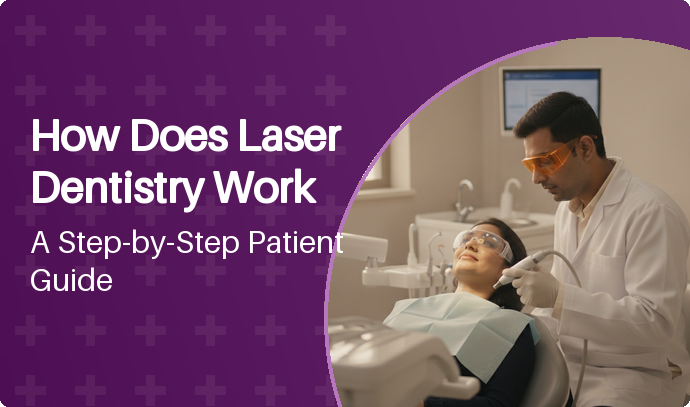
A laser dentistry appointment follows the same safety checks as any other procedure at Galaxy Dental Care, with the added step of selecting the right laser wavelength for your tissue type. Your dentist first examines your mouth, reviews your medical history and current medicines, and confirms the treatment plan. Protective eyewear is given to you and the dental team. The dentist then directs the laser beam at the target area, using short pulses or continuous light depending on the job. For soft-tissue work like gum reshaping or removing overgrown tissue, the laser seals small blood vessels as it cuts, so you see less bleeding than with a scalpel. For hard-tissue work like removing decay, the laser vaporises the infected material while leaving healthy tooth structure intact. The appointment length is usually comparable to conventional methods, though many patients report less discomfort afterward.
At Galaxy Dental Care, Laser Dentistry is performed by dentists trained in laser protocols, with in-house OPG full-mouth X-rays and CBCT 3D scans available to plan cases precisely. If you are considering Teeth Whitening, our laser-assisted whitening activates the gel to break down stain molecules faster than non-laser methods.
How does laser dentistry work on soft tissue versus hard tissue?
Laser dentistry works differently on soft tissue and hard tissue because each tissue absorbs light energy at different wavelengths. Soft tissue like gums contains high water content, so lasers such as the carbon dioxide (CO2) laser and diode laser are readily absorbed, cutting cleanly and sealing capillaries to reduce bleeding. Hard tissue like enamel and dentin contains minerals that require different wavelengths, such as those produced by erbium-doped yttrium aluminum garnet (Er:YAG) lasers, which can remove decay and prepare cavities without generating the heat and vibration of a conventional drill. The dentist chooses the laser type based on the specific procedure and your individual tissue characteristics.
Patients who need Advanced Gum Treatments often benefit from soft-tissue laser work because the laser can decontaminate periodontal pockets and reshape gum lines with minimal trauma. For children, a Pediatric Dentist may use laser options for certain soft-tissue procedures to reduce anxiety and speed recovery.
Is laser dentistry safe and what are the real risks?
Laser dentistry is safe when performed by trained clinicians using FDA-approved equipment and proper eye protection for everyone in the room. The main risks are tissue damage from incorrect settings, eye injury without protective goggles, and incomplete treatment if the laser is used inappropriately for a complex case. Some procedures still require traditional tools alongside or instead of the laser. Outcomes depend on individual case and oral health status. Your dentist at Galaxy Dental Care will tell you if laser treatment is suitable or if a conventional approach is safer for your specific condition.
Before any laser procedure, we check your gum health, bone support via OPG or CBCT where needed, and review conditions like diabetes or blood-thinning medication that could affect healing. This is the same thorough assessment we apply to Dental Implants and other treatments. For families, Pediatric Dentist in Nallagandla follows the same planning steps to determine if laser options are appropriate for children.
What conditions can laser dentistry treat at Galaxy Dental Care?
Laser dentistry at Galaxy Dental Care treats a defined set of gum and soft-tissue conditions, with select applications for hard tissue and whitening. Approved uses include gum reshaping for aesthetic or functional reasons, removal of overgrown or damaged soft tissue, treatment of periodontal pockets, teeth whitening activation, and biopsy of oral lesions. The laser is not a universal replacement for all dental tools; some cases still need conventional surgery, drilling, or referral to an oral surgeon. Your complete treatment plan is shared with you before any procedure begins, including whether laser or conventional methods are recommended.
Decontamination of pockets, removal of diseased tissue
Advanced bone loss may require flap surgery
Tooth decay
Hard-tissue laser removes select decay
Deep decay near pulp may need conventional approach
Teeth whitening
Activates whitening gel for faster results
Intrinsic stains may need veneers or other options
Oral lesions or biopsy
Clean excision with good visibility
Suspicious lesions sent for pathological analysis regardless
How do I know if laser dentistry is right for me?
You know laser dentistry is right for you after a consultation where your dentist examines your mouth, reviews your medical history, and explains which procedures would use laser and which would not. Good candidates generally have healthy gums or manageable gum disease, no conditions that severely impair healing, and a treatment goal that matches what lasers do well, such as gum contouring or select decay removal. Patients with pacemakers, certain skin conditions, or who are taking photosensitising medications may need modified protocols or non-laser alternatives. The decision is always individual and based on clinical findings rather than marketing claims.
At Galaxy Dental Care, every patient is shown their diagnosis and given a full treatment plan before any procedure begins. Our multispeciality team includes periodontists and oral surgeons who assess complex cases together. We are open Monday to Sunday, 9 AM to 9 PM, with a 24/7 emergency phone line for post-treatment concerns. To find out if laser treatment fits your needs, call us at +91 86866 76781 for an assessment.
Laser dentistry uses concentrated light to treat gums, soft tissue and select hard-tissue problems with less bleeding and often faster recovery than conventional methods. It is not needed for every procedure, but it is a valuable option when matched to the right patient and condition. At Galaxy Dental Care, trained dentists assess your case, explain your options clearly, and perform laser procedures with proper safety protocols. Call +91 86866 76781 to book a consultation and learn whether laser treatment suits your situation.
FAQs
Does laser dentistry hurt less than traditional methods?
Many patients report less discomfort during and after laser dentistry because the laser seals nerve endings and blood vessels as it works, reducing both pain and bleeding. However, pain perception varies by individual and procedure type, so your dentist will discuss anaesthesia options for your specific case.
How long does healing take after laser gum treatment?
Soft-tissue laser procedures often heal within one to two weeks, which is typically faster than scalpel surgery because the laser causes less trauma to surrounding tissue. Your dentist will give you specific aftercare instructions, including when to resume normal eating and brushing.
Is laser dentistry more expensive than conventional treatment?
Laser dentistry may cost more per procedure due to equipment and training costs, but the exact difference depends on the treatment needed and your individual case. Galaxy Dental Care provides a complete treatment plan with costs before any procedure begins, and accepted dental insurance provider tie-ups are available.
Can children have laser dental procedures?
Yes, select laser procedures are suitable for children, particularly for soft-tissue issues like tongue-tie release or gum overgrowth, because the reduced noise and vibration can lower anxiety. A pediatric dentist will assess whether your child is a candidate based on their specific condition and cooperation level.
Are there any conditions where laser dentistry should not be used?
Laser dentistry may not be suitable for patients with certain pacemakers, uncontrolled diabetes, active infections, or those taking photosensitising medications, as these conditions can affect safety or healing. Your dentist reviews your full medical history and current medicines before recommending any laser procedure.