Category: Root Canal

  • How to Know If You Need a Root Canal Treatment: 5 Warning Signs

    How to Know If You Need a Root Canal Treatment: 5 Warning Signs

    How to know if you need a root canal treatment is a question patients ask when a tooth hurts and does not settle. The clearest signs are pain that stays after hot or cold food, throbbing that wakes you at night, sharp pain when you bite, a pimple-like swelling on the gum, or a single tooth turning grey or brown. These mean the soft nerve tissue inside the tooth, called the pulp, may be infected or dying. Galaxy Dental Care checks this with cold tests, gentle tapping, and an OPG full-mouth X-ray or CBCT 3D scan to see inside the bone. Our endodontists and general dentists work together to confirm whether the tooth can be saved with Root Canal Treatment or needs a different approach. By the end of this article, you will know which symptoms mean you should book a consultation within 24 to 48 hours.

    Key takeaways

    • Lingering pain after heat or cold that lasts more than 30 seconds suggests pulp inflammation needing prompt assessment.
    • Throbbing night pain that wakes you usually means the nerve is severely inflamed and unlikely to heal without treatment.
    • A gum boil or swelling near a tooth often signals a dental abscess, which can spread without root canal treatment.
    • Only clinical tests and X-rays can confirm the diagnosis; self-diagnosis by symptoms alone is not reliable.
    • A root canal treated tooth can last many years with a proper crown and regular check-ups.

    What does a tooth needing a root canal treatment feel like?

    A tooth needing Root Canal Treatment usually gives warning signs before the pain becomes constant. The most telling feeling is pain that lingers after you drink something hot or cold. Healthy teeth feel temperature for a few seconds. When the pulp inside is inflamed, that ache can last 30 seconds or more. Another common feeling is a dull throb that builds and does not respond to painkillers well. Some patients feel sharp, electric pain when they bite down or release pressure. This happens when the ligament around the tooth root is irritated by infection spreading from inside the tooth. A tooth that turns darker than its neighbours, especially after an injury, may also have a dying nerve. These signs are not proof on their own, but they are reasons to see a dentist within one to two days.

    Which symptoms mean you should call a dentist quickly?

    Certain symptoms need faster attention than others. Use this table to judge urgency.

    Symptom What it suggests When to call
    Pain lingering over 30 seconds after hot or cold Inflamed or dying pulp Within 24 to 48 hours
    Throbbing pain that wakes you at night Advanced pulp inflammation Same day or next morning
    Sharp pain on biting or releasing pressure Infection at root tip irritating surrounding bone Within 24 hours
    Gum swelling or a pimple with pus Dental abscess Same day, especially with fever
    Tooth turning grey or brown after trauma Internal bleeding and nerve death Within a few days, sooner if painful

    A dental abscess is a pocket of infection that can spread to the face or jaw if left untreated. If you notice swelling with fever, difficulty swallowing, or spreading redness, seek emergency care. Galaxy Dental Care offers a 24/7 emergency phone line for such situations. Signs You Need a Root Canal: Don’t Ignore These Symptoms covers these warnings in more detail.

    How does a dentist confirm you need a root canal treatment?

    Symptoms guide the dentist, but tests confirm the diagnosis. At Galaxy Dental Care, the check starts with your description of the pain: where it is, what triggers it, how long it lasts, and what relieves it. The dentist then examines the tooth and surrounding gum. A small pimple on the gum, called a fistula, often points to a chronic abscess even when pain is mild. The dentist may tap the tooth gently with a metal instrument. Pain on tapping suggests inflammation around the root tip. A cold test checks if the nerve inside still responds. A tooth that feels nothing, or one that hurts long after the cold is removed, usually has pulp damage. Electric pulp testing gives a similar reading using a mild current. These chairside tests are paired with imaging. An OPG full-mouth X-ray shows the whole jaw and can reveal dark areas around root tips that indicate bone loss from infection. A CBCT 3D scan gives cross-sectional views of bone density, root shape, and how close nerves or sinuses lie. This matters for planning complex cases. The dentist also checks your medical history, current medicines, and conditions like diabetes that affect healing. Only after this full assessment is Root Canal Treatment recommended or ruled out.

    What happens during root canal treatment?

    Root canal treatment removes infected or dead pulp tissue, cleans the hollow space inside the tooth, and seals it to stop reinfection. The steps are straightforward once the diagnosis is clear.

    1. Access opening: The dentist numbs the area, then opens the top of the tooth to reach the pulp chamber.
    2. Canal cleaning: Small instruments remove the soft tissue and bacteria from the narrow root canals. Disinfectant irrigants flush the space.
    3. Shaping: The canals are shaped to allow a tight filling.
    4. Filling: A rubber-like material called gutta-percha seals the canals. A temporary or permanent filling closes the tooth.
    5. Crown placement: Most back teeth need a crown afterward to prevent fracture, as root canal treated teeth become more brittle.

    The procedure usually takes one to two visits. The first visit relieves pain and places medication inside. The second visit, a week or so later, completes the filling. A single-visit root canal is possible for straightforward cases. Afterward, mild soreness for two to three days is normal and manageable with over-the-counter pain relief. If you are anxious about discomfort, read How Painful Is Root Canal Treatment Really: What to Expect for a frank explanation.

    Can you avoid needing a root canal treatment?

    Some root canals are unavoidable, such as after deep decay or trauma. Many others are preventable with timely care. The main cause is untreated tooth decay that reaches the pulp. A simple Dental Filling at the cavity stage stops this progression. Gum disease can also expose tooth roots to infection; Teeth Scaling and Advanced Gum Treatments protect against this. Good habits reduce risk significantly: brush twice daily with fluoride toothpaste, floss to clean between teeth, and have dental check-ups every six months. At Galaxy Dental Care, preventive care includes Preventive Dentistry and Teeth Cleaning to catch problems early. If you grind your teeth, a night guard prevents cracks that let bacteria enter the pulp. Wear a mouthguard for sports. These steps do not guarantee you will never need a root canal, but they shift the odds in your favour.

    What if the tooth cannot be saved?

    Not every painful tooth can be kept. If the root is cracked below the gum line, if too much tooth structure is lost to decay, or if bone support is severely damaged, extraction may be the only option. In these cases, the gap can be filled with a Dental Implant, a bridge, or a partial denture. Dental Crowns and Full Mouth Rehabilitation are also options for rebuilding function. The key is not to delay assessment. A tooth that might have been saved with a root canal can become unsalvageable if infection destroys too much surrounding bone. Root Canal Treatment in Kondapur follows the same careful planning steps, with in-house imaging and multispeciality backup if the case is complex.

    What you feel What it usually means What to do
    Sensitivity to cold that fades in under 10 seconds Receding gums or early wear, not pulp death Mention at next check-up
    Pain that starts with sweet foods Decay near the nerve, still possibly fixable with a filling Book within a week
    Constant ache with visible gum swelling Established infection, likely needs root canal or extraction Book within 24 hours
    No pain but dark tooth after a knock Nerve may be dying silently X-ray needed within 1 to 2 weeks

    Five warning signs that indicate a tooth may need root canal treatment5 Signs You May Need a Root CanalCheck your symptoms against these warning signs to decide whento call a dentist.1Lingering heat sensitivityPain that continues more than 30 seconds after hot orcold suggests inflamed pulp tissue inside the tooth.2Throbbing night painAche that worsens when lying down often means advancednerve inflammation that will not heal withouttreatment.3Sharp pain on bitingDiscomfort when chewing or releasing pressure pointsto infection spreading to the ligament around the roottip.4Gum swelling or pimpleA raised bump with possible pus discharge signals achronic abscess that needs prompt dental attention.5Tooth colour changeA single tooth turning grey or brown after trauma ordecay indicates internal bleeding and nerve death.Symptoms guide you, but only a dentist's tests and X-raysconfirm the need for treatment.Galaxy dental care+91 86866 76781

    Knowing how to know if you need a root canal treatment comes down to watching for lingering pain, night throbbing, biting sensitivity, gum swelling, or colour change. These signs, confirmed by cold tests and X-rays, tell a dentist whether the pulp inside your tooth can be saved. Galaxy Dental Care offers diagnosis with OPG and CBCT imaging, treatment by endodontists, and follow-up care Monday to Sunday, 9 AM to 9 PM. If you have any of these symptoms, call +91 86866 76781 to book an assessment. Early checking keeps more options open.

    FAQs

    Can a tooth that needs a root canal heal on its own?

    No. Once the pulp inside a tooth is infected or dying, it cannot repair itself because the tissue has no blood supply to fight infection. The pain may ease temporarily if the nerve dies completely, but the infection remains and can spread to the jaw bone. A dentist must remove the infected tissue or extract the tooth.

    How long can you wait before getting a root canal treatment?

    You should not wait more than a few days once symptoms appear. Lingering pain or a gum swelling means active infection. Delay increases the risk of the tooth fracturing, bone loss around the root, or the infection spreading to the face and neck. Same-day assessment is safest for throbbing night pain or any swelling with fever.

    Is a root canal treatment more painful than a filling?

    The procedure itself is not more painful because the tooth is numbed with local anaesthetic. Most patients feel pressure but not sharp pain. The soreness afterward is usually stronger than after a simple filling and lasts two to three days. Over-the-counter pain relief manages this well for most people.

    Why does my tooth hurt more when I lie down?

    Lying flat increases blood flow to the head, which raises pressure inside an inflamed tooth pulp. This is why throbbing pain often worsens at night and wakes patients. It is a classic sign that the nerve inside is severely inflamed and unlikely to settle without root canal treatment or extraction.

    Can antibiotics avoid the need for a root canal treatment?

    Antibiotics can reduce swelling and pain from a dental abscess, but they do not cure the infection inside the tooth. The dead or infected pulp has no blood supply, so antibiotics cannot reach it. The infection returns once the medication stops. Root canal treatment removes the source, or the tooth must be extracted.

    What happens if I do nothing and leave the tooth alone?

    The infection can spread from the tooth root into the surrounding bone, causing a larger abscess. This may lead to facial swelling, difficulty opening the mouth, or in rare cases, spread to deeper neck spaces. The tooth may also crack as the internal structure weakens, making later extraction more difficult.

  • How Painful Is Root Canal Treatment Really: What to Expect

    How Painful Is Root Canal Treatment Really: What to Expect

    How painful is root canal treatment really is the question that keeps many people awake at night. In one clinical study, the average pain level during the procedure was 1.2 out of 10, and more than half of patients felt no pain at all. The treatment is designed to remove infected pulp and relieve the pain of a damaged tooth, not to cause it. At Galaxy Dental Care, endodontists and general dentists perform root canals using local anaesthesia and digital planning. Before any procedure, you receive a diagnosis, an OPG or CBCT scan if needed, and a full treatment plan with options. By the end of this article, you will know exactly what pain to expect, when it happens, and how to tell normal soreness from a problem that needs a call back.

    Key takeaways

    • Root canal treatment scores an average of 1.2 out of 10 for pain during the procedure, with 54% of patients reporting no pain at all.
    • Local anaesthesia makes the procedure itself largely comfortable; pain before treatment is usually worse than the treatment itself.
    • Mild soreness after the anaesthetic wears off is normal and typically managed with over-the-counter pain relievers.
    • You should contact your dentist if pain worsens after a few days, swelling increases, or you develop a fever.

    What actually happens during root canal treatment?

    Root canal treatment is a procedure that removes infected or inflamed soft tissue, called pulp, from inside your tooth. The dentist drills a small opening in the tooth, cleans out the pulp chamber and root canals, disinfects the space, and seals it with a filling material. A crown is often placed later to protect the tooth.

    Before starting, the dentist numbs the area with local anaesthesia. At Galaxy Dental Care, the team also reviews your medical history and may take an What is Digital Dentistry and How It Can Ease Treatments and Diagnosis scan to plan the procedure precisely. The goal is to save your natural tooth and stop the pain caused by infection, not to create new pain.

    How painful is root canal treatment during the procedure?

    Root canal treatment during the procedure itself is typically not painful. One clinical study found the average pain level was 1.2 out of 10, and 54% of patients reported feeling no pain at all. Patients are six times more likely to describe a root canal as painless compared to a tooth extraction.

    The key factor is effective local anaesthesia. When the tooth is properly numbed, you may feel pressure or movement, but sharp pain is rare. If you feel discomfort during the procedure, tell your dentist immediately so additional anaesthetic can be given. At Galaxy Dental Care, every Root Canal Treatment is performed with careful attention to your comfort, and the option for a temporary restoration is discussed if multiple visits are needed.

    What you might feel What it means What to do
    Pressure or vibration Normal during drilling and cleaning Stay still; signal if it becomes sharp
    Mild warmth from tools Friction from dental instruments Usually harmless; mention if uncomfortable
    Sharp pain Anaesthetic may need topping up Raise your hand and tell the dentist immediately

    What soreness is normal after root canal treatment?

    After root canal treatment, some soreness is normal once the anaesthetic wears off. This is because the tissues around the tooth have been worked on and the body is beginning to heal. The pain you came in with, caused by infection or inflammation inside the tooth, should be gone.

    Most patients describe the after-sensation as similar to having had a filling, with tenderness when biting down or touching the area. Over-the-counter pain relievers are usually sufficient. The American Association of Endodontists notes that any post-treatment discomfort is generally mild and short-lived compared to the pain of the original infection.

    Symptom Normal or not? When to call
    Mild soreness when chewing Normal for a short period If not improving after several days
    Slight tenderness to touch Normal If it worsens or spreads
    Swelling that increases Not normal Contact your dentist immediately
    Fever or feeling unwell Not normal Contact your dentist immediately

    How does root canal pain compare to leaving the tooth untreated?

    Leaving an infected tooth untreated causes significantly more pain than root canal treatment. The infection inside the tooth pulp contains nerves and blood vessels, and as it spreads, it can cause throbbing pain, swelling, abscess formation, and damage to surrounding bone and tissue.

    Root canal treatment removes this source of pain entirely. While the procedure and brief recovery involve some manageable sensations, the alternative is ongoing, often escalating discomfort and the risk of tooth loss. At Galaxy Dental Care, the team uses Category: Root Canal protocols that prioritise early intervention to prevent complications. You can also read about Signs You Need a Root Canal: Don’t Ignore These Symptoms to understand when to seek help.

    What can you do to minimise discomfort before and after root canal treatment?

    Before your appointment, eat a normal meal unless instructed otherwise, and take any regular medications as prescribed. Avoid alcohol before the procedure, as it can interfere with anaesthesia. After the procedure, follow your dentist’s instructions for care, which typically include avoiding very hard or hot foods on the treated side until the permanent restoration is placed.

    For after-soreness, over-the-counter pain relievers are usually recommended. Keep the area clean with gentle brushing and avoid smoking, which delays healing. If a temporary filling was placed, be careful not to dislodge it. Galaxy Dental Care provides a complete treatment plan before any Treatment begins, including aftercare instructions and a follow-up schedule. Consultations and follow-up visits are available Monday to Sunday, 9 AM to 9 PM, with a 24/7 emergency phone line for post-treatment concerns.

    Timeline comparing pain levels before, during, and after root canal treatmentRoot Canal Pain: What to ExpectSee how pain changes from before to after treatment.1Before treatmentInfection inside the tooth causes throbbing pain thatoften disrupts sleep and eating.2During treatmentLocal anaesthesia keeps the procedure comfortable,with most patients feeling little to nothing.3After treatmentMild soreness is normal and usually managed withover-the-counter pain relievers.4When to callContact your dentist if pain worsens, swellingincreases, or you develop a fever.Root canal treatment relieves the pain of infection, notcauses it.Galaxy dental care+91 86866 76781

    Root canal treatment is far less painful than its reputation suggests, with most patients experiencing minimal to no discomfort during the procedure itself. Any after-soreness is typically mild and short-lived. The real risk lies in delaying treatment and allowing infection to spread. If you have tooth pain, swelling, or sensitivity, call Galaxy Dental Care on +91 86866 76781 to book an assessment and discuss your options.

    FAQs

    Is root canal painless for everyone?

    No procedure is painless for absolutely everyone, but root canal treatment scores very low on pain scales. One study found 54% of patients felt no pain at all, and the average pain level was 1.2 out of 10. Rare discomfort usually occurs when anaesthesia needs adjustment, which your dentist can address immediately.

    What causes root canal problems in the first place?

    Root canal problems are caused by deep decay, repeated dental procedures on the same tooth, cracked or chipped teeth, or trauma that allows bacteria to enter and infect the pulp inside. Early signs include prolonged sensitivity to hot or cold, severe toothache, and gum swelling near the affected tooth.

    How can I avoid needing a root canal?

    Regular dental check-ups, prompt treatment of cavities, wearing a mouthguard during sports, and avoiding chewing very hard objects can help prevent the damage that leads to root canal problems. Good daily oral hygiene with proper brushing and flossing is also essential.

    Why do some people say root canal is bad?

    Much of the fear comes from outdated information or confusion between the pain of the infection and the treatment itself. Modern techniques, effective anaesthesia, and digital planning have made root canal treatment a comfortable procedure for the vast majority of patients.

    What happens if root canal treatment fails?

    If a root canal fails, which is uncommon, the infection may persist or return. Options include retreatment, which repeats the root canal procedure, or in some cases, surgical removal of the root tip or tooth extraction followed by a replacement such as a dental implant or bridge.

  • How Long Does a Root Canal Take? Single Sitting vs Multiple Visits?

    How Long Does a Root Canal Take? Single Sitting vs Multiple Visits?

    You’ve just been told you need a root canal. The first thing most patients want to know isn’t whether it hurts. It’s how many times they have to come back.

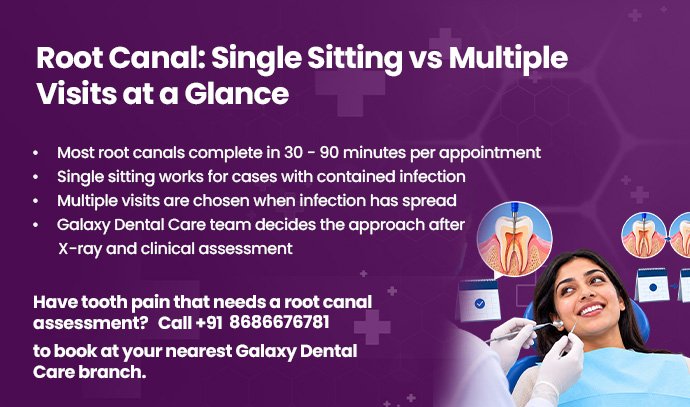
    Most root canals are completed in a single sitting of 30 to 90 minutes. Some cases need two visits. Neither approach is wrong. The number of appointments depends on the tooth, the infection, and what the dentist finds once the canals are accessed. 

    At Galaxy Dental Care, root canal treatment is handled by a dedicated endodontic team across 9 branches in Hyderabad. Endodontists are specialists in treating the inside of the tooth: the canals, the pulp, and the infection. With 100,000+ patients treated, the team uses X-ray and CBCT-based assessment before deciding on single or multiple visit treatment.

    What follows covers how long each appointment takes and single sitting vs multiple visits.

    How Long Does a Root Canal Take Per Appointment?

    A root canal appointment  typically runs between 30 and 90 minutes. Where your case falls on that range depends mostly on which tooth is being treated.

    • Front teeth have a single canal and are easier to access. A root canal on an incisor or canine often completes in 30 to 60 minutes. 
    • Premolars usually have one or two canals and sit in the middle of that range. 
    • Molars are at the back of the mouth, harder to reach, and often have three or four canals to clean. These regularly take 60 to 90 minutes or more.
    Tooth Type Number of Canals Typical Appointment Duration
    Incisors (front teeth) 1 30 to 60 minutes
    Canines 1 30 to 60 minutes
    Premolars 1 to 2 45 to 75 minutes
    Molars 3 to 4 60 to 90+ minutes


    A few other things add time beyond the tooth itself. Severely curved canals need slow, careful instrumentation. Calcified canals, where the canal has narrowed over years, take longer to locate and navigate. A significant infection may need additional irrigation before the canals can be sealed.

    single sitting vs multiple visits rct

    Single Sitting Root Canal: When It Works Best?

    A single sitting root canal means the entire procedure is completed in one appointment: cleaning the canals, removing infected pulp, disinfecting, and sealing. The patient leaves with a permanent seal inside the tooth and a crown placed or scheduled.

    The advantages of single sitting RCT, include fewer appointments, no temporary filling between visits, and comparable long-term success to multiple visit treatment. 

    A 2026 clinical survey found 81% of endodontists report no difference in long-term success between single and multiple visit root canal treatment. Single sitting RCT works well when:

    • The infection is contained to the tooth and hasn’t spread into surrounding bone
    • Canals are accessible and not heavily calcified
    • Tooth doesn’t have an active abscess with significant swelling
    • The patient can comfortably sit for 60 to 90 minutes
    • A dentist confirms adequate anaesthesia has taken effect before starting

    The best root canal treatment in Hyderabad is done under local anaesthesia. The area is numbed before anything begins. Most patients report feeling pressure and vibration rather than pain. Discomfort in the 24 to 48 hours after the appointment is manageable with over-the-counter pain relief.

    Multiple Visit Root Canal: When It’s the Better Choice?

    Multiple visits to a root canal near me​ aren’t a sign that something went wrong. Some cases genuinely need two or three visits to achieve the best long-term result. Completing everything in one sitting isn’t always the right call.

    • If an abscess has formed and the infection has reached the surrounding bone, the dentist often cleans the canals in the first visit and places antibiotic medication inside the tooth. This sits in the canal for one to two weeks. The tooth is then sealed at the second visit once the infection has reduced.
    • Canal complexity is the second reason multiple visits are chosen. Some teeth, particularly in older patients or those who’ve had previous dental work, have canals that have narrowed significantly over time. Locating and cleaning these takes longer than a single appointment.
    • Patients with significant pre-treatment pain, large infections, or particular medical conditions may be at higher risk of a flare-up between visits. The best root canal treatment near me may clean the canals at the first visit, place antibiotic medication, and seal with a temporary filling. This reduces flare-up risk before the second appointment completes treatment.

    Between visits, a temporary filling seals the opening in the tooth. It protects the canals from bacteria and keeps the tooth functional while healing continues. It isn’t a permanent solution. It’s a deliberate part of the treatment plan. 

    The Tooth That Needed a Root Canal, Deserves Galaxy Dental Care.

    If you’ve been putting off a root canal because of the time commitment or the fear of multiple visits, this is worth knowing: the procedure is far more straightforward than its reputation suggests.

    Galaxy Dental Care endodontist team handles painless root canal treatment in Hyderabad across 9 branches, open Monday to Sunday, 9 AM to 9 PM. Every case begins with an X-ray assessment before the number of visits is decided.

    We’ve treated 100,000+ patients since 2008 across Hyderabad. The procedure starts with proper numbing before anything begins. Our team knows when one visit is enough and when two visits are the safer choice.

    Call +91 8686676781 to book your appointment.

    Frequently Asked Questions

    Can a root canal be done in one sitting?

    Yes, for most cases. A single sitting root canal works well when the infection is contained to the tooth, the canals are accessible, and the patient can sit comfortably for the duration.

    Does a root canal hurt during the procedure?

    The tooth and surrounding area are numbed with local anaesthesia before the procedure begins. Most patients feel pressure and the vibration of instruments rather than pain during the appointment. If any discomfort is felt, the endodontist adjusts the anaesthesia before continuing. 

    How long does the soreness last after a root canal?

    Mild soreness around the treated tooth is normal for 24 to 48 hours after the appointment. Over-the-counter pain relief manages this comfortably for most patients. 

    Where can I find the best root canal treatment near me in Hyderabad?

    Galaxy Dental Care offers root canal treatment across 9 Hyderabad branches: Kondapur, Kukatpally, Banjara Hills, Chandanagar, Nallagandla, AS Rao Nagar, Kompally, Manikonda, and Vanasthalipuram. All branches are open Monday to Sunday, 9 AM to 9 PM. 

  • Root Canal Treatment Cost In Hyderabad

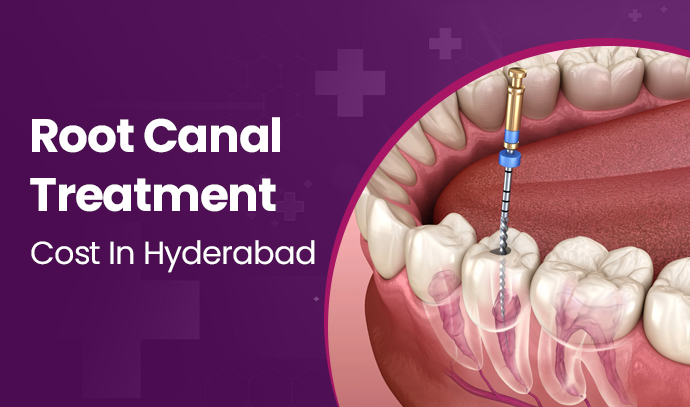
    Root Canal Treatment Cost In Hyderabad

    The cost of root canal treatment in Hyderabad ranges between ₹2,500 to ₹12,000+ per tooth, and changes as per tooth type, number of canals, infection level, and whether you need a crown after treatment. You should ask for a written plan that separates the root canal procedure from add-ons..

    Most people search for root canal treatment cost in Hyderabad, because they want to know whether the tooth can be saved, how comfortable the procedure will feel, and will the treatment be properly planned from start to finish.

    At Galaxy Dental Care, a clear explanation of how many canals are involved, whether the case is straightforward or complex, and whether the tooth will need a crown afterward is given. The treatment flows as local anaesthesia, pulp removal, cleaning and shaping, filling and sealing, and final restoration. 

    If you are looking for root canal treatment in Hyderabad that feels comfortable and planned, this guide will help you understand the price, the inclusions, and how to compare RCT plans more clearly before you book.

    What Is The Average Root Canal Treatment Cost In Hyderabad?

    The root canal treatment cost in Hyderabad changes tooth-wise and costs up to ₹12,000 per tooth. Molars cost more because they have more canals and take longer time. Clinics may quote different numbers because the case changes and the quote format changes. 

    Tooth Type Typical RCT Range In Hyderabad
    Front tooth (single canal) ₹2,500 to ₹6,000
    Premolar (1 to 2 canals) ₹4,000 to ₹10,000
    Molar (multiple canals) ₹4,500 to ₹12,000+
    Re-root canal (Re-RCT) ₹6,500 to ₹12,000+


    A crown cost is often separate, and that can change your total bill. If your search is the best root canal treatment near me, do not compare only the lowest number. Compare what the quote includes and whether a crown is part of the plan.

    Why Does The Cost Of Root Canal Treatment In Hyderabad Change From One Tooth To Another?

    Cost changes because different teeth have different canal anatomy, and back teeth need more time, more access control, and cleaning work. This is why molars cost more than front teeth. Here are the main factors that change the cost of root canal treatment in Hyderabad:

    • Tooth type and canal count: Front teeth have one canal, molars often have multiple canals.
    • Infection level: Deep infection can increase steps and visits.
    • Re-treatment cases (Re-RCT): If a past root canal failed, the dentist near me may need additional steps, and the cost increases.
    • Access difficulty: Back teeth sit deeper and have less working space, which affects time.
    • Restoration plan: Many teeth need a crown after treatment, and that changes the total.

    This is why you will see different quotes for the root canal. The tooth and the plan decide the price.

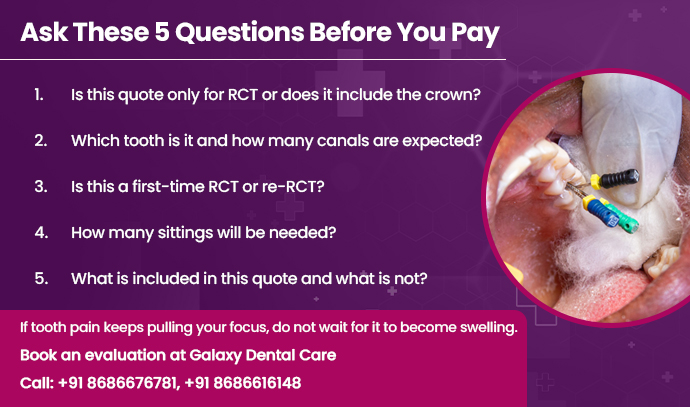
    ask these 5 questions before you pay

    What Is Included In A Root Canal Cost Quote, And What Is Extra?

    A clear root canal quote should list what is included in the procedure and what sits outside it, like crown, post-core, or extra imaging. If a quote feels too short, ask for a written breakup.

    Often included 

    • Consultation and clinical exam
    • Local anesthesia
    • X-ray for diagnosis
    • Cleaning and sealing of canals
    • Temporary filling after the procedure
    • A follow-up check if needed

    Often extra

    • Additional X-rays if needed 
    • Re-RCT (repeat root canal)
    • Post and core build-up 
    • Final crown after the root canal
    • CBCT scan in complex cases

    If you are comparing best root canal treatment in Hyderabad options, ask for the same quote format from every clinic. That keeps comparisons fair.

    Does A Crown Increase The Root Canal Treatment Cost In Hyderabad, And When Do You Need It?

    Yes, a crown can increase the total price of root canal treatment in Hyderabad. Dentists recommend it for back teeth because they take heavy chewing pressure. A root canal saves the tooth, but the crown protects it from cracking later. When a crown is recommended:

    • Molars and premolars after RCT, because they handle stronger bite forces.
    • Teeth with large cavities or large old fillings.
    • Teeth that already have cracks or weak walls.

    How Many Visits Does Root Canal Treatment Take?

    Some root canals finish in one sitting, but infected teeth or complex canals may need more than one visit for safety and comfort. The best root canal treatment in Hyderabad decides based on infection and anatomy.

    • Single visit: when infection is limited and canals are straightforward.
    • Two or more visits: when infection is deeper, there is swelling, or the tooth needs medication in between visits.

    If you search for painless root canal treatment in Hyderabad, your comfort will depend on proper numbing, careful step-by-step cleaning, and not rushing the case. 

    Book A Root Canal Cost Review At Galaxy Dental Care Hyderabad

    A good root canal is not only about removing infection from inside the tooth. It is also about how the procedure feels in the chair, how clearly each step is explained, and how well the tooth is protected afterward. For one patient, the treatment may finish in a single visit. For another, infection control, re-treatment, or a crown may change the plan. That is why the first consultation matters so much. 

    At Galaxy Dental Care, a comfort-focused process is followed using modern anaesthesia thus, providing painless root canal treatment in Hyderabad. The full sequence from cleaning and sealing the canals to restoring the tooth with a crown where needed, is handled properly offering long-term success of an RCT and the final protection of the tooth. 

    Patient-facing testimonials on Galaxy pages also mention that the root canal experience felt comfortable and pain-free, reinforcing the chairside trust many patients are looking for. Book a consultation at Galaxy Dental Care for the best root canal treatment near me , Call: +91 8686676781, +91 8686616148.

  • Things You Should Know Before Going Through The Root Canal Procedure

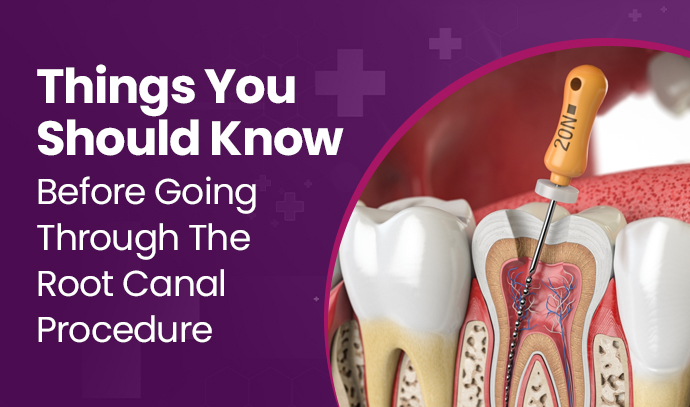
    Things You Should Know Before Going Through The Root Canal Procedure

    Is tooth pain keeping you awake? Has a dentist advised a root canal, and now you feel nervous about what will happen? Most people ask the same questions: Will the root canal procedure hurt? How long will it take? What should you do before you come in? What will you feel after it is done? Who offers the best root canal near me? 

    Here is the clear answer. Before you go through a root canal procedure, you should know how the dentist controls pain, what steps the dentist follows, how long the visit usually takes, and what normal root canal recovery time looks like. When you know these points in advance, you walk in calmer and avoid last minute surprises.

    In this blog, our expert dentists at Galaxy Dental Care answer the most common worries patients have before a root canal. Read through this blog to get clarity and confidence, and book an appointment for painless root canal treatment in Hyderabad ​with our experienced team when you are ready.

    What Are The Most Important Things To Know Before A Root Canal Procedure?

    You feel less stressed when you know what the dentist will do and what you will feel. These are the most important things to know before the root canal procedure.

    • The dentist numbs the tooth, so you should not feel sharp pain.
    • The numbness usually starts in about 10 minutes.
    • The dentist places a rubber dam to keep the tooth clean and dry.
    • The dentist usually completes the treatment in 45 to 90 minutes.
    • The dentist often finishes many cases in one sitting.
    • You usually feel pressure or mild vibration, not pain.
    • You may feel mild soreness after the numbness wears off.
    • The dentist often advises a crown later to prevent the tooth from cracking.

    Tell the dentist about diabetes, blood pressure, allergies, medicines, or strong anxiety before starting. This helps the dentist plan your comfort and safety.

    How Can You Tell If You Really Need A Root Canal Procedure?

    The dentist recommends RCT when infection reaches the nerve inside the tooth and the tooth cannot heal on its own. The dentist confirms this with an exam and an X-ray.

    These signs often point to the need for RCT.

    • You feel pain that keeps coming back, especially at night.
    • You feel hot or cold sensitivity that lasts longer than a few seconds.
    • You feel pain when you bite down.
    • You notice swelling or tenderness near the tooth.
    • You see a darker tooth after injury or deep decay.

    Treating the tooth early usually keeps the plan simpler and protects the tooth better.

    What Should You Do Before Coming In For A Root Canal Procedure?

    You prepare best when you keep your body comfortable and your mind calm. These steps support a smoother visit and help the dentist treat the tooth without delays.

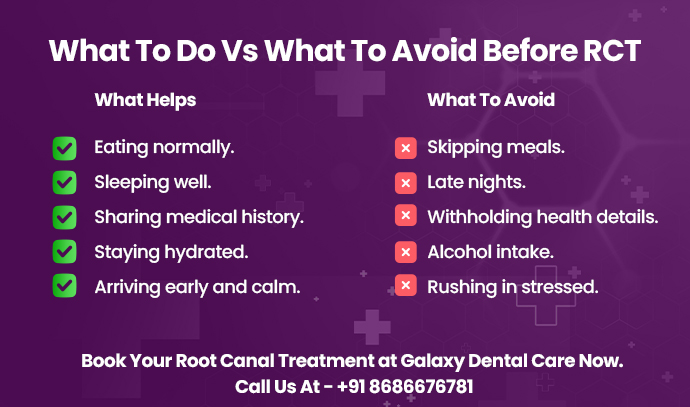
    Do these simple things before your appointment.

    • Get a good night’s sleep.
    • Eat a normal meal unless the dentist plans sedation.
    • Drink water and stay hydrated.
    • Avoid alcohol before the visit.
    • Avoid tobacco on the day of treatment if possible.
    • Carry a list of your medicines.
    • Share medical conditions and allergies with the clinic.
    • Wear comfortable clothing and avoid tight neckwear.
    • Arrive a little early so you do not rush.
    • Arrange transport if you feel very anxious or expect sedation.

    What Should You Tell The Dentist Before The Root Canal Procedure Starts?

    You help the dentist plan safer care when you share your health details upfront. This avoids surprises during treatment.

    Tell the dentist if any of these apply.

    • You have diabetes, blood pressure issues, or heart conditions.
    • You take blood thinners or long term medicines.
    • You have allergies to medicines or local anaesthesia.
    • You recently had fever, infection, or illness.
    • You are pregnant or recently had a medical procedure.
    • You feel strong dental anxiety or fear injections.
    • You notice pain that increases when you bite or lie down.

    If you feel very anxious, ask about comfort options before starting. This helps the dentist keep the procedure calm and controlled.

    root canal procedure

    How Long Does The Root Canal Procedure Take And Will It Be Completed In One Sitting?

    The dentist completes many cases in one sitting. The visit usually takes about 45 to 90 minutes. The dentist plans the time based on the tooth and infection level.

    These situations can make it take longer or need another visit.

    • The tooth has multiple canals or curved canals.
    • The infection runs deep or has lasted long.
    • The tooth needs re-treatment.
    • The dentist needs extra cleaning to control infection.

    The dentist explains the likely time and visit count before starting, so you know what to expect.

    What Should You Eat Or Avoid Before A Root Canal Procedure?

    Eat a normal meal before you come in, unless the dentist plans sedation and gives different instructions.

    Do this before the visit.

    • Eat a normal meal.
    • Drink water and stay hydrated.
    • Choose soft foods if the tooth feels very sensitive.

    Avoid this before the visit.

    • Avoid alcohol.
    • Avoid tobacco.
    • Avoid very hot foods if heat triggers pain.
    • Avoid chewing on the painful side.

    These steps support preparing for root canal treatment in a safe way.

    What Are Common Myths You Should Not Worry About Before A Root Canal Procedure?

    Old stories create fear. Modern dentistry changes the experience.

    Ignore these common RCT myths.

    • A root canal procedure always hurts. The dentist numbs the tooth first.
    • Extraction is always better. The dentist often saves the natural tooth for better function.
    • RCT always needs many visits. The dentist finishes many cases in one sitting.
    • Pain lasts for weeks. You may feel mild soreness, but severe pain is not expected.
    • The tooth becomes weak forever. The dentist protects it with a crown when needed.

    Choose a dental clinic that explains the plan clearly before starting. If you are searching for root canal treatment in Hyderabad, best root canal treatment in Hyderabad, or painless root canal treatment in Hyderabad, Galaxy Dental Care offers the best dental treatments. 

    Book Your Appointment For Root Canal Treatment In Hyderabad At Galaxy Dental Care Now!

    When tooth pain is involved, choosing the right clinic is about feeling confident and understood, not rushed. You should feel comfortable asking questions, knowing how pain will be managed, and understanding what happens before, during, and after the procedure.

    At Galaxy Dental Care, root canal treatment is planned with clarity and care. Dentists take time to explain why RCT is needed, how the procedure will be done, and what recovery usually looks like. The focus stays on saving the natural tooth, maintaining strict hygiene, and ensuring patient comfort at every step.

    If you are looking for root canal treatment in Hyderabad, painless root canal treatment in Hyderabad, or the best root canal treatment near you, booking an appointment at our dental clinic helps you get clear answers first and treatment only when you are ready.

    Call us now at +91 8686676781 to schedule your consultation for the best root canal treatment near me in Hyderabad. 

  • Signs You Need a Root Canal: Don’t Ignore These Symptoms

    Signs You Need a Root Canal: Don’t Ignore These Symptoms

    Introduction


    Root canal therapy often has a scary reputation, but it’s actually a routine procedure that can save a damaged tooth. The earlier you catch signs of infection or nerve damage, the more likely you can avoid complications and severe pain. Knowing what symptoms to look for is the first step.

    What is a Root Canal?

    A root canal is a dental procedure that involves removing infected or inflamed pulp (the soft tissue inside the tooth), disinfecting the space, and then sealing it to prevent further infection. This saves the tooth from extraction and helps maintain the natural structure of your mouth.

    Common Symptoms Indicating You May Need a Root Canal

    1. Severe Toothache
      • Throbbing or persistent pain could indicate that the tooth’s pulp is infected or inflamed.
    2. Prolonged Sensitivity
      • If hot or cold foods cause lingering discomfort, it might signal nerve damage.
    3. Swollen or Tender Gums
      • Infection can spread beyond the tooth, causing inflammation in the surrounding gum tissue.
    4. Darkening of the Tooth
      • A tooth that is turning gray or black from the inside may have a dying nerve.
    5. Pimple on the Gums (Fistula)
      • A small, raised bump near the affected tooth can be an indication of an abscess or chronic infection.

    The Root Canal Procedure

    1. Assessment and X-Rays: Your dentist will examine the tooth and use X-rays to check the extent of the infection.
    2. Local Anesthesia: The tooth and surrounding area are numbed to ensure minimal discomfort.
    3. Cleaning the Canal: The dentist removes infected pulp and disinfects the canal.
    4. Filling and Sealing: A biocompatible material is used to fill the canal, and a filling or crown is placed to protect the tooth.

    Recovery and Aftercare

    • Mild Discomfort: You may experience slight tenderness after the procedure, which can usually be managed with over-the-counter pain relievers.
    • Oral Hygiene: Continue regular brushing, flossing, and using mouthwash to maintain dental health.
    • Follow-Up Appointment: Your dentist may schedule a check-up to ensure the tooth is healing properly.

    Conclusion

    If you notice any of these symptoms—especially persistent tooth pain or swelling—it’s crucial to consult a dentist. A root canal can relieve discomfort, prevent further complications, and save your natural tooth in the long run.