
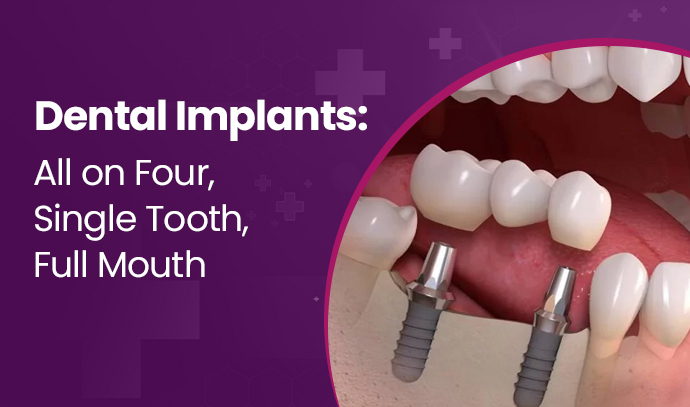
Missing teeth can disturb daily life in ways people do not always say out loud. Dental implants offer fixed solutions for missing teeth, from replacing one lost tooth to restoring an entire arch or full mouth. All on Four Dental Implants support a complete arch on four strategically placed implants, while other implant plans may replace a single tooth or multiple teeth depending on the condition of the mouth.
At Galaxy Dental Care, treatment options include Single Tooth Implants for isolated gaps, full-arch implant solutions for wider tooth loss, and broader restoration plans when several teeth across the mouth need replacement. These options aim to restore chewing ability, stability, and long-term oral function.
The implant team at Galaxy Dental Care has created this guide to help you understand what each implant option means and which situation it usually fits. Keep reading to see how these solutions work in real-life cases.
What Is The Difference Between Single Tooth, All on Four, and Full Mouth Dental Implants?
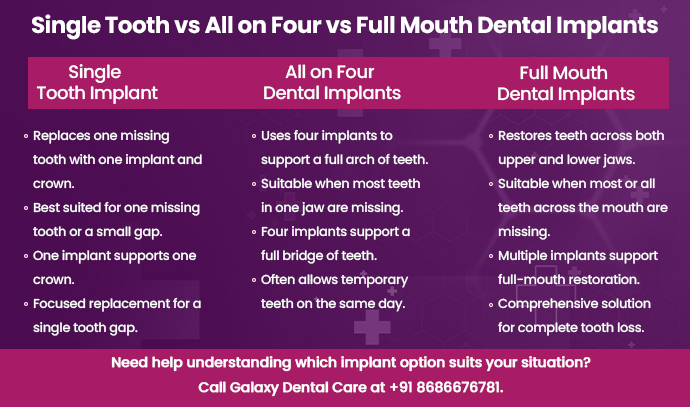
Dental implant treatment is not one fixed format. Single Tooth Implants replace one missing tooth, while All on Four Dental Implants support a complete arch of teeth on four implants. Full-mouth implant treatment usually restores both jaws when many teeth are missing. The difference mainly lies in how many teeth need replacement and how much support the mouth requires.
Single Tooth Implants: Best When The Problem Is Just One Gap
A single tooth implant replaces one missing tooth without affecting the teeth next to it. Single Tooth Implants use a titanium implant placed in the jaw to support a crown that functions like a natural tooth.
This option is commonly recommended when:
- One tooth is lost due to decay, injury, or extraction.
- Nearby teeth are healthy and do not need support work.
- A visible gap affects the smile or chewing comfort.
- A fixed solution is preferred instead of a removable option.
For many people needing dental implant near me, this is the most direct treatment when the problem involves just one missing tooth.
All on Four: Built For A Full Set Of Teeth In One Jaw
All on Four Dental Implants replace an entire arch of teeth using four implants placed strategically in the jawbone. Two implants are usually positioned in the front and two at an angle in the back to provide strong support for a full bridge of teeth.
This treatment is usually considered when:
- Most or all teeth in one jaw are missing.
- Dentures feel unstable or uncomfortable.
- Remaining teeth cannot support long-term restoration.
- A patient wants a fixed full-arch solution.
People go to the best dental implants in hyderabad and explore this option when they want a better alternative for removable dentures.
Full Mouth Dental Implants: When The Whole Mouth Needs Support
Full Mouth Dental Implants restore teeth across both jaws when the problem affects the entire mouth. Instead of replacing one tooth or one arch, treatment focuses on rebuilding overall chewing support and stability.
This option may be recommended when:
- Many teeth are missing across the mouth.
- Remaining teeth are too weak or damaged to save.
- Dentures no longer provide comfortable support.
- Bite strength and chewing function have reduced significantly.
The best dental implants treatment in Hyderabad offers a fix for all of this!
Which Missing Teeth Situation Usually Calls For Which Implant Option?
The right implant option depends on how many teeth are missing and how much support your mouth needs. People searching for dental implants in hyderabad usually want to know which treatment fits their actual tooth loss situation, not just the treatment name.
Scenario 1: You lost one tooth, but the rest of your teeth are healthy
A single missing tooth after decay, injury, or extraction usually needs a smaller and more focused plan. In this kind of case, one implant and one crown can replace the gap without disturbing the nearby teeth.
Scenario 2: You have a few missing teeth, but not the whole jaw
Your dentist will check where the gaps are, how strong the remaining teeth feel, and whether your bite still has proper balance. This stage needs careful planning before choosing the right support.
Scenario 3: You have almost no teeth left in one jaw
This is the point where All on Four Dental Implants may be considered. It can support a full set of fixed teeth in one upper or lower arch.
Scenario 4: You have very few teeth left across the mouth
When tooth loss affects both jaws, treatment usually needs a wider full-mouth plan. The aim is to restore chewing, comfort, and daily function.
How Do Dentists Decide Which Implant Option Fits Your Mouth?
Dentists do not choose implants by looking at the gap alone. They study the bone, gums, bite, and overall mouth condition before they suggest dental implants treatment in Hyderabad for any patient.
| What dentists check | Why it matters |
|---|---|
| Number of missing teeth | This shows if the case needs one implant, a full-arch plan or wider restoration. |
| Bone density and bone volume | A strong bone helps hold the implant better in place. |
| Position of the missing teeth | Front teeth, back teeth and full-arch gaps all need different planning. |
| Gum health | Healthy gums support healing and long-term stability. |
| Remaining teeth | Weak or failing teeth may change the treatment plan. |
| Bite balance | The dentist checks how the upper and lower teeth work together. |
| General health | Healing ability may change with smoking or certain medical conditions. |
Dentists also rely on 3D imaging and digital scans to study the jawbone before planning treatment. These scans help them measure bone support, map the exact implant position, and avoid sensitive structures in the jaw. Many patients searching dental implant near me assume treatment depends only on the number of missing teeth, but proper implant planning depends on the strength and condition of the entire mouth.
What Actually Happens During Dental Implant Treatment?
Dental implant treatment happens in planned stages. It does not usually start and end in one visit. Hence, people get dental implants in Hyderabad in several visits.
- Step 1: Your dentist studies the mouth first – The process starts with a full check of the teeth, gums, bite, and jawbone. Scans and X-rays help the dentist see bone support clearly and plan the implant position with more accuracy.
- Step 2: The implant goes into the jawbone – The dentist places a titanium implant into the bone under local anaesthesia. Most patients find the procedure more comfortable than they expected because the area stays numb during treatment.
- Step 3: The bone heals around the implant – This healing phase is called osseointegration. It usually takes about 2 to 6 months. During this time, the bone gradually fuses with the implant and creates a stable base.
- Step 4: The support piece is attached – Once healing is complete, the dentist connects an abutment to the implant. This small connector holds the final crown, bridge, or larger restoration in place.
- Step 5: The final tooth or teeth are fixed – The last step is the visible restoration. This may be a single crown, a bridge or a larger full-arch solution, depending on the treatment plan.
They may also use a temporary tooth if the gap shows while you smile. Mild swelling or soreness can happen for 24 to 48 hours after the procedure.
If you are comparing the best dental implants in Hyderabad, know that not every person heals the same way. Neither in duration nor in process. This depends on bone quality, gum health and treatment type.
How Long Do Single Tooth, All on Four, and Full Mouth Dental Implants Take?
Treatment time changes with the type of implant plan and how the bone heals.
- Single Tooth Implants usually take about 3 to 6 months because the implant needs time to fuse with the jawbone before the final crown is placed.
- All on Four Dental Implants can often give a patient temporary teeth on the same day. The final permanent teeth usually come after about 3 to 6 months, once healing is complete.
- Full Mouth Dental Implants usually take longer. In more complex cases, treatment may take about 8 to 12 months because both jaws may need staged planning, healing, and final restoration.
- Bone grafting can extend treatment by another 3 to 6 months in some cases. Healing speed, bone support, and overall mouth condition also affect the final timeline.
Rebuild Your Smile With Advanced Dental Implants at Galaxy Dental Care
Galaxy Dental Care offers complete implant solutions for different tooth loss situations. Our team provides single tooth implants, all on four dental implants, and full mouth dental implants using digital planning and guided placement. Patients looking for best dental implants in Hyderabad often choose implant treatment to restore chewing strength, speech comfort, and smile confidence. Our implant services focus on stable, natural-looking teeth that function like real ones.
If missing teeth or unstable dentures affect your daily life, the right solution is available with dental implant near me services at Galaxy Dental Care. Call +91 8686676781 and book your implant consultation today.
FAQs
Are All on Four and Full Mouth Dental Implants the same?
Not exactly. All on Four usually restores one full arch with four implants. Full mouth treatment usually means both jaws need a bigger restoration plan.
What are the benefits of choosing dental implants instead of bridges or dentures?
Dental implants stay fixed and feel more stable while eating or speaking. They also do not depend on nearby teeth the way a bridge does.
Are dental implants painful?
Most people find the procedure easier than they expected because the area stays numb during treatment. You may feel mild soreness after, but dentists usually help manage that well.
How do you know which implant treatment is right for you?
Your dentist checks the number of missing teeth, bone support, gum health, and bite. That is why the right answer comes after an exam, not from guessing online.
Can dental implants work if you have weak teeth, bone loss, or old dentures?
In many cases, yes. Your dentist will first check the bone and overall mouth condition, then decide whether implants can work safely for you.
